
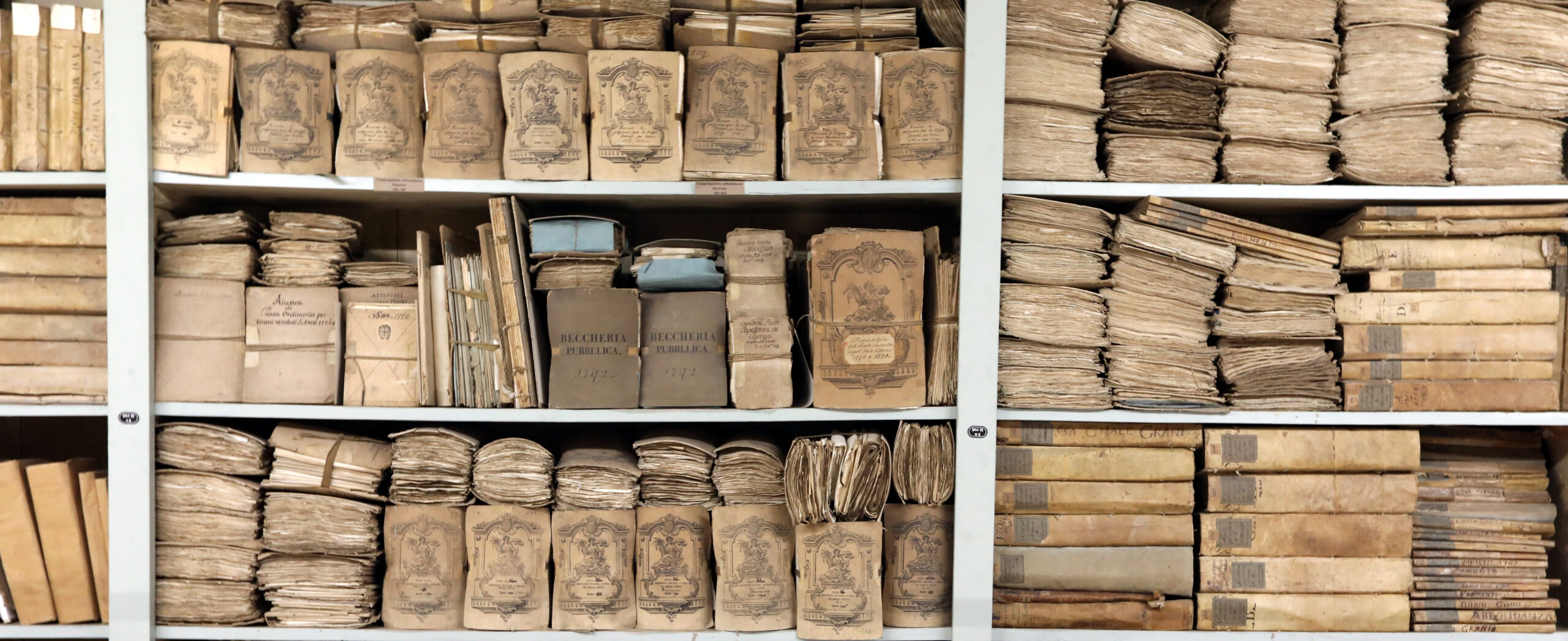
Reliable archival research is not simply a matter of finding documents in an archive. At Archivitaly, it is understood as a structured process of investigation, verification, coordination, and critical interpretation. While archival work is often imagined as a matter of entering a repository and locating sources, reliable research depends on something far more complex: the ability to transform uncertain historical questions into coherent and methodologically supervised research paths. This is particularly true in Italy, where archival research frequently unfolds across fragmented institutional landscapes, historical cataloguing systems, uneven inventories, restricted fonds, and collections whose internal logic is not always immediately visible from published finding aids or national descriptive systems such as SIUSA alone. Under these conditions, reliability depends not only on consultation itself, but on the quality of the research process surrounding it.
Reliability begins before the archive visit
Most archival projects do not begin with a complete shelfmark or a precisely identified document. More often, they begin with uncertainty: a partial citation, an undocumented provenance claim, a name without dates, a family tradition, a bibliographic reference copied decades earlier, or an object whose documentary history remains unclear. For this reason, a significant part of archival work takes place before any document is ever consulted. At Archivitaly, research projects begin with the transformation of a broad historical question into an operational archival strategy. This involves identifying relevant institutions, narrowing the chronological scope, tracing name variants, assessing possible archival series, evaluating access conditions, and determining whether the question itself can realistically be approached through surviving documentation.
In many cases, the feasibility of archival work depends on factors that remain invisible from catalogues alone: a fonds may technically survive but be temporarily inaccessible; a reference may correspond to an outdated shelfmark; a diocesan archive may require prior authorisation; a collection may be distributed under retrieval limitations that significantly affect consultation times. Particularly in Italy, reliable archival research therefore begins long before the reading room itself, through careful documentary orientation, planning, and verification.
Local archival knowledge matters
Reliable archival research also depends heavily on local expertise. Many Italian collections remain only partially catalogued, historically reorganised, or unevenly described, meaning that the practical understanding of how a specific archive functions often becomes just as important as the formal inventory itself. For this reason, Archivitaly works through a network of local archivists and researchers who possess direct familiarity with the institutions, collections, and documentary structures of the territories in which they operate. Knowledge of the archive’s internal organisation, consultation practices, retrieval procedures, and documentary peculiarities frequently allows research paths to emerge that would remain difficult to identify through catalogues alone. A researcher familiar with a particular archive may recognise useful connections between fonds, identify overlooked documentary series, or understand how historical administrative structures shaped the organisation of the surviving material. Local expertise can therefore significantly reduce uncertainty, avoid unproductive lines of enquiry, and help adapt the research strategy as new evidence emerges. At the same time, local expertise alone is rarely sufficient. At Archivitaly, archival findings are not treated as isolated discoveries to be simply transmitted to the client. Materials, references, and emerging documentary patterns are continuously reassessed within the wider context of the research question itself.
Research requires coordination and critical supervision
One of the most persistent misconceptions about archival research is the idea that the work consists simply in locating and forwarding documents. In reality, consultation is only one phase within a much broader research workflow. As archival work progresses, findings often require comparison with earlier references, contradictory evidence, bibliographic material, or newly emerging documentary patterns. A source initially believed to be central may prove marginal, while an apparently secondary document may radically reshape the direction of the investigation. Equally important, negative findings may become just as significant as positive discoveries, helping narrow the scope of the research and prevent the repetition of unproductive paths. For this reason, Archivitaly structures archival research as a coordinated and critically supervised process. Local archival work is continuously integrated into a broader methodological framework designed to ensure coherence, interpretive caution, and consistency across the project as a whole. For Archivitaly, reliable archival research is therefore not the result of a single archive visit, but of a supervised process in which local findings are continuously tested against the wider research question. In more complex investigations involving provenance, attribution, legal history, family reconstruction, or fragmented documentation, archival material rarely “speaks for itself”. Its relevance, evidential value, historical context, and interpretive limits must all be continuously evaluated as the research develops. This ongoing process of reassessment and scholarly supervision forms an essential part of our research model.
Reporting is part of the research itself
The reliability of archival work also depends on how findings are documented, organised, and transmitted. A photograph without context, a partial transcription, or an isolated reference detached from its archival structure may easily produce misunderstanding or future verification problems. For this reason, Archivitaly places particular emphasis on structured reporting and documentary traceability. Complete shelfmarks, concise summaries, coherent photographic documentation, methodological notes, and the explicit distinction between verified evidence and working hypotheses all form part of the research process itself, not merely its final presentation. This applies equally to negative findings. The confirmation that a source does not survive, cannot currently be accessed, or does not contain the expected information, remains an important research result. Properly documented negative evidence prevents duplication of effort, narrows future investigations, and contributes to a more accurate understanding of the documentary landscape. At Archivitaly, our role is not simply to retrieve documents, but to construct, supervise, and critically evaluate the research process through which documentary evidence becomes historically meaningful. This is why reliable archival research depends not on the certainty of a predetermined outcome, but on the rigor, transparency, and methodological consistency of the process itself.
Image credit: © Biblioteche e Archivio Storico, Comune di Modena


