
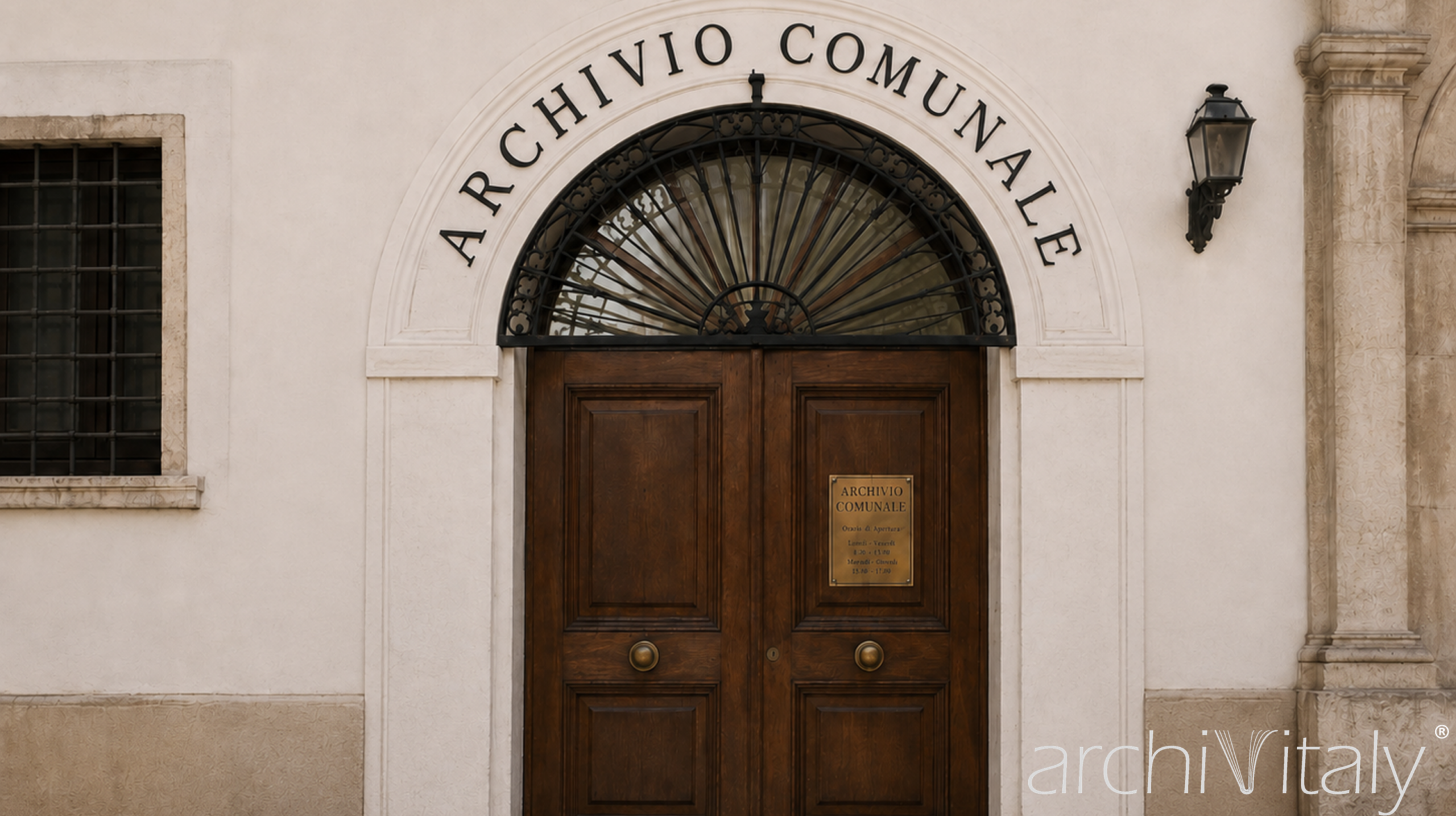
Municipal archives in Italy are often approached as though their contents could be inferred directly from their name. A researcher may expect council deliberations, local regulations, accounts and administrative correspondence: the records created by a municipality in the course of governing its territory. Those materials are certainly central, but they do not necessarily define the full extent of what a municipal archive preserves. This distinction matters because the term “municipal archive” (archivio comunale, in Italian) can describe both the archive produced by a municipal administration and the institution or repository responsible for conserving historical records. The two are closely connected, but they are not identical. A civic repository may preserve the municipality’s own papers alongside archives created by earlier governing bodies, suppressed institutions, charitable organisations, professional groups, families, individuals or other entities whose records entered municipal custody for specific historical reasons. The result is a documentary landscape that can be considerably richer, and less predictable, than the institutional label suggests.
The documentary archive of a municipality
At its core, a municipal archive records the activities through which a local administration governed a community. Its holdings may document the decisions of councils and executive bodies, correspondence with central and regional authorities, taxation, budgets, public works, property management, urban planning, public health, education, welfare, elections and civil registration. Such records provide more than a history of municipal bureaucracy. They show how decisions affected streets, buildings, institutions and individual inhabitants. A deliberation may record the approval of a public project; an account book may reveal who supplied materials or received payment; correspondence may preserve disputes, requests and negotiations that are absent from the final administrative act. The organisation of these papers reflects the administrative history of the municipality itself. The Italian archival administration’s work on municipal archives has long addressed the systems used to classify and preserve records produced by local government, including the enduring influence of the classification framework introduced by the 1897 Astengo circular. Yet even within the municipal fonds, uniformity should not be assumed. Series may begin or end at different dates, administrative responsibilities may have shifted between institutions, and war, natural disasters, neglect, transfers or earlier reorganisation may have altered what survives. The apparent absence of a record can therefore have several explanations and should not immediately be treated as evidence that it never existed.
A repository may hold more than the municipal fonds
Historical municipal archives frequently contain what Italian inventories describe as fondi aggregati: archives of other bodies or persons preserved alongside the records of the municipality. These collections retain their own institutional history and archival identity, even though they are now held by the same repository. This is not a marginal phenomenon. Inventories available through the Italian Sistema Informativo Unificato per le Soprintendenze Archivistiche, or SIUSA, show municipal repositories preserving the papers of charitable institutions, agrarian communities, local associations, schools, public utilities, judicial bodies, welfare organisations and former municipalities. At Norcia, for example, the described aggregated holdings include records of local associations, a municipal band, a cooperative and organisations connected with welfare and employment. At Arrone, they include judicial records, communal land institutions, charitable bodies and organisations concerned with water management. The presence of such records does not mean that every municipal archive will contain the same categories of material. It means precisely the opposite: the holdings of each repository are the product of a particular local history. Administrative suppression, institutional succession, deposit, transfer, acquisition and local collecting policies can all influence what eventually enters municipal custody. For this reason, “municipal archive” should be understood as the beginning of an enquiry, not as a complete description of the material available.
The Archivio Storico Capitolino and Rome’s notarial records
The Archivio Storico Capitolino offers a particularly instructive example. Its holdings naturally include records relating to Rome’s civic administration, but its documentary scope is not limited to papers produced by the municipality. Among its collections is the Archivio Notarile Generale Urbano. The archive’s published descriptions include the Rubricella dei rogiti originali dei Notari Antichi di Roma, covering the letters A–C in two volumes, as well as a series of sections containing notarial and related records extending from the Middle Ages into the nineteenth century. These include records of notaries and writers of the Archivio della Romana Curia, Jewish notaries and notaries serving converts, private receipts, wills and other distinct documentary groupings. The example is important not because it should be treated as representative of every Italian municipality, but because it exposes the weakness of reasoning from an institution’s name alone. A researcher looking for Roman notarial references might instinctively direct the enquiry exclusively towards the Archivio di Stato di Roma. That would overlook the separate historical formation of the Archivio Generale Urbano and the material now accessible through the Capitoline archive. The correct repository is determined by the history of the records, not by a modern assumption about where a particular documentary type ought to be found.
What municipal archives can reveal
Municipal records can support research into the physical and institutional development of a place. Public works papers, building files, council proceedings and administrative correspondence may clarify when a road was altered, a school opened, a market regulated or a building adapted to a new use. Financial and contractual documentation may identify contractors, suppliers, architects or local officials involved in those changes. They can also illuminate social history. Civil registration, population records, electoral documentation, relief and welfare files, school papers and local administrative correspondence can place individuals within a community and show their relationship with public institutions. Such evidence must be interpreted with care, particularly where records contain personal or sensitive information, but it can provide a dimension of local life that is difficult to reconstruct through national institutions alone. Where aggregated fonds survive, the possibilities widen further. The archive of a charitable institution may reveal patterns of assistance and patronage; the records of a local association may document political or cultural networks; the papers of a suppressed body may preserve evidence predating the modern municipality. In exceptional cases, as at the Archivio Storico Capitolino, notarial holdings may open routes into property, inheritance, family and commercial history that would not ordinarily be associated with a municipal repository.
Finding the relevant archive requires institutional research
The most effective way to investigate a municipal archive is not to begin with a generic list of document types. It is to identify the body that created the evidence and then reconstruct the institutional history that may explain where its archive is now held. SIUSA is particularly valuable for this purpose. The Italian Ministry of Culture describes it as the principal access point for information about non-state public and private archival holdings preserved outside the State Archives. Its descriptions distinguish between archival complexes, the institutions, people or families that produced them, the bodies that currently preserve them, and the inventories or other research tools through which they can be consulted. This separation between producer and custodian is essential. A record may have been created by a charitable body, a former municipality or a professional institution but now be conserved by a modern Comune. Conversely, records concerning a town may be preserved in a State Archive, a diocesan archive, a library or another repository rather than in the municipal archive itself. Once an inventory or reference has been identified, its terminology and hierarchy should be recorded precisely. As discussed in Archivitaly’s guide to archival shelfmarks in Italy, the name of the repository, the fonds, the series and the individual archival unit perform different functions and should not be collapsed into a generic description of the subject matter.
The name of the archive is not its table of contents
Municipal archives preserve the administrative memory of local government, but they may also preserve documentary histories that extend beyond it. Their collections can reflect institutional succession, changing territorial structures, the disappearance of earlier bodies and the deliberate acquisition or safeguarding of archives considered significant for the history of a community. This makes them indispensable for local and urban history, but also potentially relevant to research into families, institutions, property, welfare, professional activity and notarial practice. At the same time, their diversity makes generalisation risky. The holdings of Rome cannot be projected onto a small provincial municipality, just as the structure of one local archive cannot be assumed to apply to another. The crucial methodological point is simple: an archive’s institutional title identifies its present context, but does not necessarily disclose the provenance or full range of the records it preserves. Before deciding that a source belongs elsewhere, the researcher must examine the inventories, the history of the collections and the relationship between the institution that produced the records and the repository that now holds them.


