
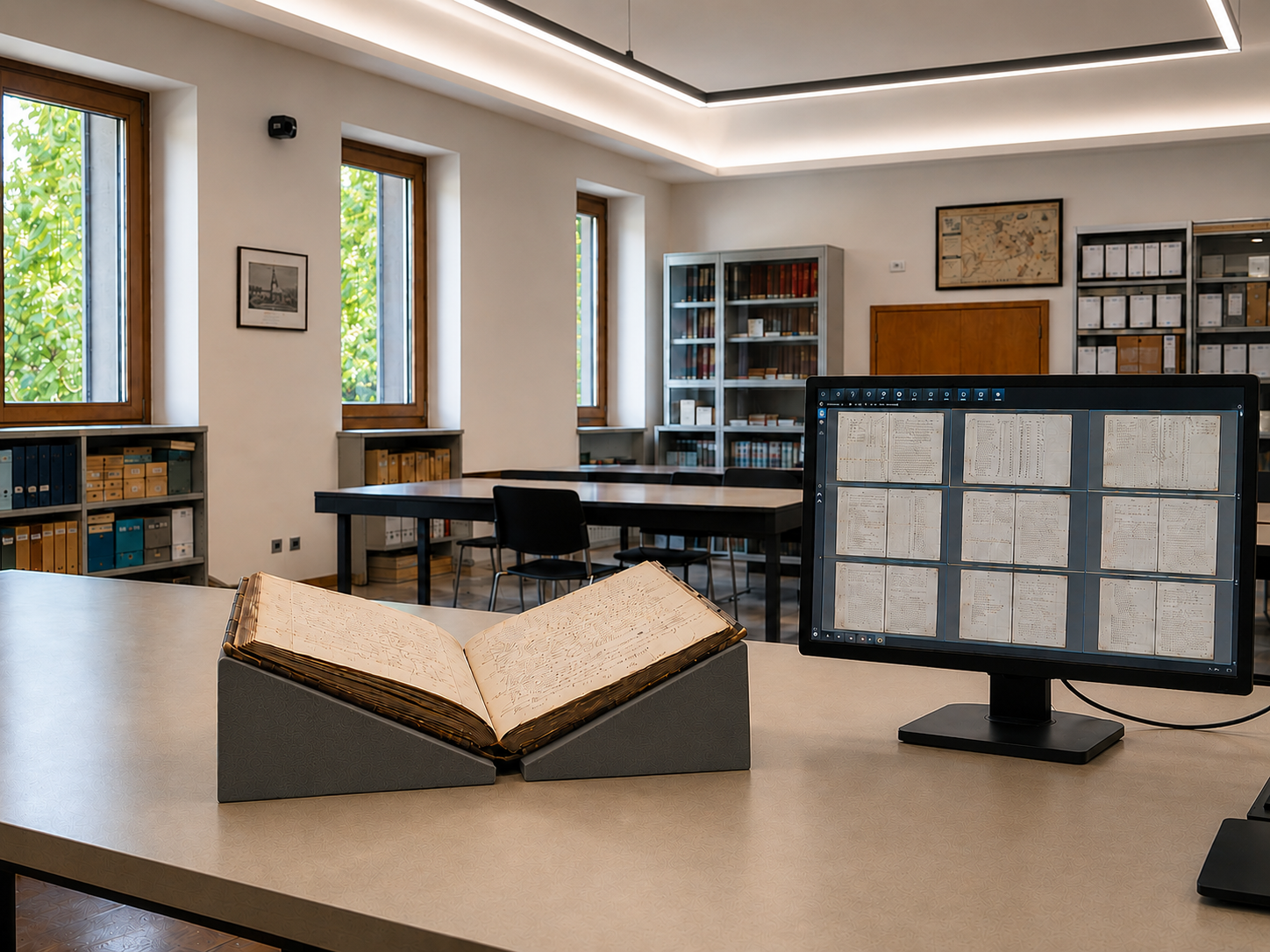
Digitised State Archives in Italy do not form a single, uniformly accessible digital collection. A researcher may encounter hundreds of thousands of images freely available online, a fonds accessible only from a computer in the reading room, or records that have already been scanned but are still awaiting migration to a public platform. The contrast can be difficult to understand. If a document already exists as a digital file, why should consulting it still require a journey to the archive? Official information published by Italian archival institutions suggests that there is no single answer. The present situation reflects successive digitisation campaigns, different technical systems, varying levels of archival description and projects conceived for different purposes. Some were designed for online access; others initially produced preservation or consultation copies; still others are now being incorporated into national or regional infrastructures. The result is best understood not as a simple divide between digitised and undigitised archives, but as a spectrum of digital availability.
Digitisation is not a single condition
The word “digitised” can conceal several materially different situations: it may mean that images have been created and stored internally; it may indicate that fragile originals have been replaced by digital consultation copies in the reading room; it can describe a database that is available remotely but contains only descriptions or indexes rather than images. At the most developed end of the spectrum, it may refer to a structured online resource in which digital reproductions are connected to archival descriptions and can be searched, consulted and cited remotely. These outcomes are not interchangeable. The Ministry of Culture’s National Plan for the Digitisation of Cultural Heritage treats image capture as only one part of the digital lifecycle. Digital objects must also be selected, checked, described, managed, preserved and connected to systems through which they can be discovered and used. Its accompanying data-management guidance distinguishes production from archiving and publication, while also requiring decisions about metadata, formats, responsibilities, preservation and any restrictions on sharing or reuse. A collection of image files may therefore exist without yet constituting a usable online archive. Researchers need to know what each image represents, how it relates to the fonds, series and archival unit, whether the sequence is complete and how the material should be cited. Without that structure, placing thousands of scans on a server would create visibility without reliable archival context.
The expanding online landscape
Italy does have substantial remotely accessible archival resources. The best-known is the Portale Antenati, which brings together digitised civil-status records from numerous State Archives. Its scale demonstrates what centralised access can achieve when images, descriptions and a shared platform are developed together. The newer Archivio Digitale platform has a broader purpose. It provides a common point of access to digitisation projects undertaken by State Archives and archival superintendencies, allowing users to explore collections or search descriptions associated with individual digital objects. In 2024, the Direzione generale Archivi issued Circular no. 25, directing institutions to use Archivio Digitale for the publication of the results of their digitisation projects. The platform itself is conceived for progressive expansion: resources become available as individual projects are prepared and transferred. Examples already online reveal both the possibilities and the selectivity of this process. At the Archivio di Stato di Milano, more than 130,000 images from the first 720 registers of the Atti dei notai di Milano were made freely accessible through Archivio Digitale. The institute has also published complete digital reproductions of military register indexes for the districts of Milan, Lodi and Monza. At the Archivio di Stato di Firenze, the 1427 Catasto is accessible through Archivio Digitale, while a subsequent project covering registers, maps, tracings and approximately 31,000 graphic records was designed to recover earlier digitisation work and add further images to the same platform. Here, image production and online publication form explicitly connected stages of the project. These cases matter because they show that the Italian digital landscape cannot be characterised simply as a mass of inaccessible scans. Considerable bodies of material are already available remotely, and the national infrastructure is continuing to absorb new projects.
Online and on-site access can coexist within the same archive
The picture becomes more complicated at institutional level. One State Archive may provide some collections online while retaining other digitised material for local consultation. The Archivio di Stato di Milano explains this distinction clearly. Its guidance directs researchers to collections and finding aids available through Archivio Digitale but cautions that not all the digital documents listed can be viewed online. Some may be consulted in digital form only at the institute. Milano is therefore neither simply “online” nor “offline”. It illustrates a hybrid condition in which the route of access depends on the particular fonds, series or digitisation project. The existence of a significant online programme does not imply that every earlier digital resource has already entered it. This distinction is particularly important during preliminary research. A negative search on the public platform cannot safely be treated as evidence that no digital reproduction exists. The images may be available only through the institution’s internal system, just as a finding aid may exist in the reading room without being retrievable through the website.
Digital collections confined to the reading room
Other institutions explicitly document digital consultation through dedicated computers or local networks. The reading-room regulations of the Archivio di Stato di Genova state that the institute holds digital copies of part of its documentary heritage and provides a workstation reserved exclusively for their consultation. Researchers must still register for the reading room and submit the appropriate consultation request. Digital reproduction changes the medium through which the records are examined, but not the geographical conditions of access. At the Archivio di Stato di Pisa, the drawings and plans of the architect Federigo Severini provide an especially clear example. The fonds is described on the Ministry’s Art Bonus platform as entirely digitised, yet consultation takes place at a dedicated computer in the reading room. Direct access to the originals is permitted only in response to a reasoned request, in order to protect the material from mechanical and chemical stress. In this case, local digitisation has an evident conservation rationale. The digital surrogate allows the archive to reduce handling of vulnerable drawings while keeping their informational content available to researchers. Remote access would broaden the value of the project, but the existing local system is not without purpose. The same model appears at the Archivio centrale dello Stato. Catalogue entries for several collections specify that digitised documentation is available through the reading room’s local network. The Francesco Saverio Grazioli fonds, for example, is described as digitised and consultable locally. Other entries identify particular series or sets of images rather than an entire fonds. These cases demonstrate that on-site digital consultation is not an anomaly peculiar to one archive or one region. It occurs in northern, central and national institutions and can apply either to whole collections or to selected portions of them.
Naples and the transition between systems
The Archivio di Stato di Napoli belongs within this wider, geographically dispersed picture. Documentation published by the Regione Campania identifies several different digitisation activities undertaken in relation to its holdings. Selected inventories from the Archivio della Maggiordomia Maggiore e Soprintendenza di Casa Reale and the Archivio Farnesiano were chosen for description and digitisation. Microfilms relating to the Consiglio Collaterale were converted into digital form, as were large-format volumes from the Corporazioni Religiose Soppresse. The regional account of the project states that this work was intended both to protect significant documents and to make them accessible online. The resulting descriptions are now represented within the Sistema Archivistico Campano, although the availability of descriptions should not be confused with complete remote access to every associated image. Naples is therefore useful as evidence of the movement between successive systems. Earlier reproductions, new digital images, archival descriptions and regional platforms have to be connected before the researcher encounters them as a coherent online resource. The case also cautions against assuming that every locally accessible digital collection represents a deliberate and permanent refusal of remote access. In at least some projects, online publication is stated as an objective while integration remains a separate phase of work.
What remains after scanning
The official sources do not support a universal explanation based on cybersecurity or institutional reluctance, nor do they justify treating privacy as the principal cause of the gap. Access restrictions are relevant for particular bodies of records. Archives may contain personal or sensitive information, and the legal assessment required for unrestricted web publication is not necessarily identical to supervised consultation of an individual file in a reading room. Rights and conditions of reuse may also affect what can be circulated or republished. Yet many of the examples discussed here concern historical material for which privacy cannot plausibly explain the entire situation. The more general obstacles are structural: earlier projects may have produced images in local systems; metadata may be incomplete or incompatible; the connection between files and archival descriptions may still need to be established; platforms require maintenance and migration; and publication must be planned as a sustainable service rather than a one-off upload. The Ministry’s digital strategy itself acknowledges the legacy of fragmented local applications and regional systems. The current emphasis on common infrastructures, interoperable data and long-term management is, in part, a response to that fragmentation.
A map in motion
No selection of examples can provide a definitive census of digitisation across all Italian State Archives. Institutional websites vary in detail, projects evolve and material can move from local consultation to online publication without the underlying scans themselves changing. The cases of Milano, Genova, Pisa, Firenze, Napoli and the Archivio centrale dello Stato nevertheless reveal a recognisable pattern. Italy’s State Archives currently encompass fully online collections, hybrid institutions, digitised holdings confined to reading-room networks and projects undergoing migration or platform integration. This is more than a technical distinction. For researchers working from abroad, a collection available on a computer in the archive remains, in practical terms, an on-site source. It may protect the original and improve consultation once the researcher arrives, but it does not remove the need to travel, register, secure an appointment or engage someone locally. As discussed in Archivitaly’s article on why archival research in Italy slows down, digital visibility is only one component of access. A catalogue entry is not necessarily linked to images; a digitised fonds is not necessarily remotely available; and an unsuccessful online search does not establish that no digital copy exists. “Digitised” should therefore be read as the beginning of a question, not as a complete description of access. The essential follow-up remains: digitised where, described how, and available to whom?


