
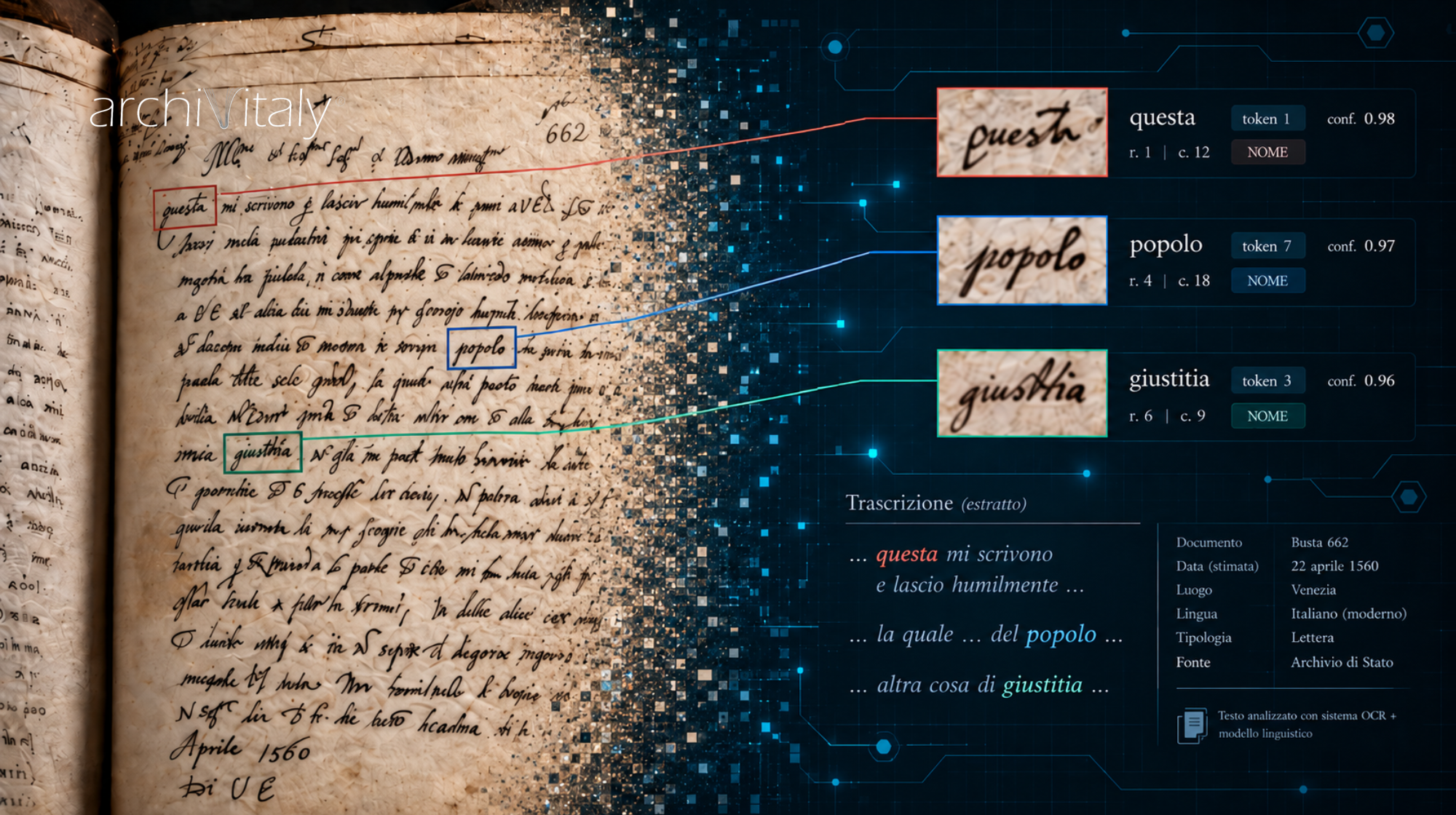
Recent advances in Handwritten Text Recognition (HTR) have changed the practical scale of manuscript research. Once largely confined to experimental or project-specific settings, HTR is now used to produce searchable text from sizeable bodies of handwritten material, making forms of retrieval and comparison possible that would be impracticable through manual transcription alone (Mühlberger et al. 2019; Nockels et al. 2022). Multimodal large language models have complicated this landscape further. Although they were not developed specifically for palaeographical work, some can now transcribe historical handwriting directly from images, with results that on particular datasets approach or exceed those of specialised recognition systems (Humphries et al. 2025). Such results make one conclusion unavoidable: it is no longer useful to ask whether artificial intelligence can read historical handwriting as though the answer were simply yes or no. On suitable material, it can do so remarkably well. Yet performance remains highly dependent on language, script, documentary type, training conditions, and the relation between a model and the corpus to which it is applied. Multilingual comparisons do not reveal a stable hierarchy in which general-purpose multimodal models consistently supersede specialised HTR, while comparative testing of HTR engines likewise shows substantial variation according to script and degree of adaptation (Crosilla, Klic and Colavizza 2025; Romein et al. 2025). The more interesting question lies elsewhere. A plausible transcription is an output; historical research requires an account of why a reading should be trusted. Once that difference matters, the problem is no longer solely one of recognition, it becomes palaeographical.
Reading a text and interpreting a written object
Computational work on handwriting predates the current interest in generative AI. Script classification, writer identification, manuscript dating, and the comparison of graphic features have all been explored for years within digital palaeography (He et al. 2016; Kestemont, Christlein and Stutzmann 2017; Cilia et al. 2020). What this work has made especially clear is that the object under study cannot be reduced to its verbal content. For palaeographical purposes, a transcription is only part of the evidence. A change of hand in the middle of a memorandum, an addition squeezed into the margin, or a form of abbreviation used nowhere else in the document may alter the way the item is dated or attributed. None of this necessarily affects the wording of the transcript. A text can therefore have been read correctly while the document has not yet been fully interpreted. This is one of the methodological difficulties of digital palaeography. Converting handwriting into data requires decisions about which features are worth recording and which can be left aside. Letterforms can be measured, recurrent graphic habits classified, and similarities between hands quantified, but such operations inevitably privilege some aspects of the written object over others. The manuscript does not cease to be material and graphic once its text has been encoded: writing survives as a particular arrangement of forms on a page, produced under specific historical conditions, and some of those forms may matter independently of the words they convey (Ciula 2017; Stokes 2015). HTR is extremely effective when the immediate task is to recover text. Other questions depend on evidence that sits partly outside the transcript. Whether two passages belong to the same hand, whether an insertion is contemporary with the main text, whether an abbreviation permits more than one expansion, or whether a script fits a proposed date all require a return to the document itself. The problem begins when a transcription is asked to support claims about authorship, chronology, or documentary history that cannot be established from lexical content alone.
.
Accuracy belongs to a corpus, not to a technology
Claims about the accuracy of AI-generated transcription are often difficult to compare because the headline figure tends to outlive the conditions under which it was obtained. An error rate is never simply a property of ‘AI’ or of ‘HTR’; it belongs to a particular model, tested on a particular body of material, under a particular transcription regime. That distinction matters more with historical documents than it might with modern printed text: indeed, a seventeenth-century notarial register, a nineteenth-century private letter, and a medieval manuscript do not present the same recognition problem. Script, language, page layout, image quality, abbreviation, orthography, and the consistency of the hand all affect performance; so does the extent to which the model has been trained or fine-tuned on comparable material (Romein et al. 2025). Recent results with multimodal language models make the point particularly well. On some eighteenth- and nineteenth-century English-language collections, general-purpose multimodal systems have performed extremely strongly, in certain tests even better than specialised HTR (Humphries et al. 2025). That does not translate neatly to other languages or documentary traditions. Multilingual benchmarking, including Italian historical material, produces a much less uniform pattern, with no single approach consistently outperforming the others across datasets (Crosilla, Klic and Colavizza 2025). This variability is especially important in archives, where repetition can be an advantage. A long run of registers produced within the same office may contain the same hands, formulae, vocabulary, and layout across hundreds of folios. Once a model has adapted to that environment, recognition can become very effective. A box of unrelated correspondence, containing several hands and languages, offers far fewer such regularities. For that reason, the useful question is rarely whether AI is ‘good at handwriting’ in the abstract. What matters is whether a given system is well matched to the documents being studied. A model that performs exceptionally on one archival series may be unremarkable on the next.
When linguistic probability becomes a palaeographical problem
Multimodal language models do more than recognise graphic forms. They also bring a strong linguistic prior to the page: when the image is ambiguous, the surrounding words help determine what the text is likely to say. In many cases this is useful, and there is nothing particularly novel about the principle. Palaeographers also rely on syntax, recurrent formulae, and comparison within the same hand when a reading is uncertain. The difficulty arises with forms that are historically authentic precisely because they are unusual: early modern documents are full of unstable spelling, local usages, unfamiliar names, technical vocabularies, and grammatical irregularities; Latin and vernacular Italian may occur side by side, while the same word may appear in several spellings even within a single document. A language model trained to favour the most probable sequence can therefore be pulled towards a more regular reading than the manuscript itself supports. The danger is easy to underestimate because the resulting text often looks convincing. A rare surname may be replaced by a common one; an odd spelling may be normalised; a formula may be completed in its expected form although the scribe wrote something slightly different. None of these errors need produce nonsense. On the contrary, they may produce cleaner prose than the source. That is also why automatic post-correction has not proved straightforward. The addition of a large language model can improve a noisy transcript, but the gains are uneven across languages, periods, and document types, and the same process may introduce new errors where an unusual historical form is mistaken for a defective one (Boros et al. 2024; Crosilla, Klic and Colavizza 2025). For archival research, the important point is not that linguistic context should be excluded from transcription. It is often indispensable. The problem is knowing when context has clarified a difficult reading and when it has begun to supply the answer in place of the surviving graphic evidence. As discussed in Why One Misread Word Changes Everything in Archives, an openly doubtful reading usually attracts attention. A fluent error is more troublesome because it gives the reader no obvious reason to return to the image. At scale, that is where a very capable recognition system can create a specifically archival problem: not unreadable text, but plausible text whose degree of certainty is difficult to see.
Why a low error rate may still conceal the important error
Character Error Rate and Word Error Rate are useful measures of recognition performance, but they say little about the historical weight of a mistake. A transcript may be highly accurate overall and still fail at exactly the point that matters most. The problem is easiest to see with names, dates, sums of money, offices, or place names. Ten minor errors in articles or formulaic phrases may have almost no effect on interpretation. One incorrect surname can alter an identification; one misread date can shift a chronology; one wrong figure can change the meaning of an account. Two transcripts with the same aggregate error rate can therefore differ considerably in evidential value. Low aggregate error rates can still be extremely useful without resolving the problem at the level of the individual reading. A transcript may be accurate enough for searching and preliminary orientation while retaining an error in a name, date, or other term on which a specific argument depends (Humphries et al. 2025). Overall performance and evidential reliability are related, but they are not the same thing. The amount of checking required will depend on what the transcript is being used for. Machine-generated text may be perfectly adequate for locating possible references across a large body of material. Once a particular occurrence is used to identify a person, establish a date, or support a provenance claim, however, that reading has to be assessed on its own terms and, where necessary, against the document image. This is why corpus-level accuracy and local evidential confidence should be kept separate. The first describes how well a system performs in general. The second concerns the individual reading on which the historical argument actually rests.
Abbreviations: recognition or expansion?
Abbreviations are a good example of where transcription stops being a purely recognitional task. An abbreviated form does not simply contain a complete modern word in compressed form. Its meaning depends on a set of writing conventions that vary by period, place, genre, and sometimes by individual hand. A transcript can deal with the same abbreviation in several ways. It may reproduce the abbreviated form, expand it, or record both. Each choice changes the relation between image and text, and recognition models learn from whatever convention has been adopted in the training material. Historical orthography and abbreviation therefore remain important variables in HTR performance, especially where a model has been trained on one editorial practice and applied to another (Romein et al. 2025). In routine material, this may cause little difficulty. Formulaic legal, administrative, or ecclesiastical records often use abbreviations in highly predictable ways, and an adapted model can resolve them with considerable consistency. Problems arise when the same sign can support more than one expansion, or when the expected reading depends on grammar, documentary context, chronology, or a particular scribe’s habits. At that point, the expansion is no longer just a transcriptional convenience. It is an interpretation. A system may choose the statistically or contextually most likely form, but that does not mean the manuscript itself excludes other readings. This is also where the distinction between transcription and translation becomes important. As discussed in What Paleography Is: Transcription vs Translation, expanding an abbreviation produces a more legible text, but it also removes part of the form in which the word survives. That loss may be trivial in a routine passage. It matters much more when the abbreviation itself is uncertain, or when the choice between two possible expansions affects the interpretation of the document.
Palaeographical evidence that never enters the transcript
A transcription can be accurate and still leave out features that matter to the history of the document. Changes of hand, marginal additions, cancellations, interlinear corrections, shifts in writing speed, or a move from formal to more cursive execution may all affect dating, attribution, or the reconstruction of how a document was produced and used. Some of these features can now be analysed computationally. Writer-identification systems can group or distinguish hands across large datasets, while image-based methods have been used to classify scripts and estimate dates from graphic patterns (He et al. 2016; Kestemont, Christlein and Stutzmann 2017; Cilia et al. 2020). This is useful precisely because the quantity of material available for comparison may exceed what one scholar could examine systematically by eye. The result, however, is still a measure of similarity rather than a historical explanation of that similarity. Two hands may resemble one another because they belong to the same writer, but resemblance may also reflect common training, institutional practice, chronology, or regional convention. The opposite problem occurs as well: one writer may change noticeably according to speed, age, writing instrument, or the formality of the text. The same caution applies to automated dating. A model trained on securely dated material can place an undated hand within a probable chronological range, but the result depends heavily on the reference corpus. If the document being tested falls outside the kinds of hands represented there, the estimate may be less informative than the numerical confidence attached to it suggests (He et al. 2016). Computational comparison can therefore extend the range of palaeographical evidence available to the researcher. What it cannot do on its own is determine why two samples are similar, or what historical conclusion should follow from that similarity.
Damage, illegibility, and reconstruction
Physical damage can make a passage difficult to read for reasons that have little to do with the script itself. Fading or abrasion may leave only fragments of individual letters, while tears and ink corrosion can remove portions of the text altogether. A poor reproduction can introduce much the same uncertainty even when the original survives in better condition. Some passages can nevertheless be recovered with reasonable confidence. Image enhancement may bring out faint traces, and repeated formulae or parallel documents can help reconstruct wording that is only partly visible. A reconstruction may be highly probable without being directly legible on the page, and that difference matters. It can also be difficult to see, from a clean transcript, where the editor has intervened. A word expanded from an abbreviation, one restored from a damaged formula, and one that is fully legible on the page may end up looking much the same. If those differences are not signalled, the transcript conceals part of the reasoning that produced it. For damaged passages, that reasoning should remain visible.
For archival research, the main advantage of automated transcription is often quite practical. It can make a large body of manuscripts searchable before anyone has read it page by page. Names, formulae, places, and recurring expressions can be retrieved from collections that would otherwise require months or years of manual transcription (Mühlberger et al. 2019; Nockels et al. 2022). Multimodal models may make this even easier in some cases, especially where there is not enough time or material to train a collection-specific HTR model. Their results can be very good on suitable corpora, although the variation between languages and document types remains substantial (Humphries et al. 2025; Crosilla, Klic and Colavizza 2025; Romein et al. 2025). That changes the order in which research can proceed. Instead of transcribing a collection first and analysing it afterwards, a researcher may begin with imperfect machine-readable text, use it to locate promising material, and return to the images only where closer examination is needed. For exploratory work, this is often sufficient. The difficulty comes later, when a machine reading stops being merely a way of finding a document and starts to support the argument itself. A name retrieved from a large corpus may look convincing in the transcript, but if that name is central to an identification or a provenance claim, the image still has to be checked. The same applies to dates, sums, titles, or any other reading on which the interpretation turns. This does not require a return to full manual transcription. It requires a more selective kind of verification. Most of the machine-generated text may never need individual checking. The passages that matter most, however, still have to be judged against the document from which they were derived.
What, then, can technology not read?
It would be difficult to draw a stable boundary around the kinds of handwriting that automated systems cannot read. That boundary has already shifted considerably, and there is little reason to assume that present limitations will remain where they are. The more difficult question begins once the transcription looks convincing. A high-confidence reading may still involve an expansion, a conjectural date, or an attribution that depends on resemblance rather than identification. These are ordinary problems of palaeographical interpretation, and automation does not make them disappear. They become especially important when a reading is used to support a historical claim. If a name is central to an identification, a date to a chronology, or a phrase to a provenance argument, the transcript has to be considered together with the evidence on the page. What was actually visible? What was supplied? Was the form normalised? Is the reading secure, probable, or merely plausible? Automated transcription is already useful for locating material, producing provisional text, and working through large runs of documents. That does not mean that every resulting reading requires manual checking. It does mean that the readings on which an argument depends still need to be judged in relation to the document itself. So the limit is not simply one of legibility. A machine may read the words correctly and still leave open the question of what those words can prove.
References
Boros, Emanuela, Maud Ehrmann, Matteo Romanello, Sven Najem-Meyer, and Frédéric Kaplan. 2024. “Post-Correction of Historical Text Transcripts with Large Language Models: An Exploratory Study.” In Proceedings of the 8th Joint SIGHUM Workshop on Computational Linguistics for Cultural Heritage, Social Sciences, Humanities and Literature (LaTeCH-CLfL 2024), 133–59. St. Julian’s, Malta: Association for Computational Linguistics. https://doi.org/10.18653/v1/2024.latechclfl-1.14
Cilia, Nicole Dalia, Claudio De Stefano, Francesco Fontanella, Claudio Marrocco, Mario Molinara, and Alessandra Scotto di Freca. 2020. “An Experimental Comparison between Deep Learning and Classical Machine Learning Approaches for Writer Identification in Medieval Documents.” Journal of Imaging 6 (9): 89. https://doi.org/10.3390/jimaging6090089
Ciula, Arianna. 2017. “Digital Palaeography: What Is Digital about It?” Digital Scholarship in the Humanities 32 (suppl. 2): ii89–ii105. https://doi.org/10.1093/llc/fqx042
Crosilla, Giorgia, Lukas Klic, and Giovanni Colavizza. 2025. “Benchmarking Large Language Models for Handwritten Text Recognition.” Journal of Documentation 81 (7): 334–54. https://doi.org/10.1108/JD-03-2025-0082
He, Sheng, Petros Samara, Jan Burgers, and Lambert Schomaker. 2016. “Historical Manuscript Dating Based on Temporal Pattern Codebook.” Computer Vision and Image Understanding 152: 167–75. https://doi.org/10.1016/j.cviu.2016.08.008
Humphries, Mark, Lianne C. Leddy, Quinn Downton, Meredith Legace, John McConnell, Isabella Murray, and Elizabeth Spence. 2025. “Unlocking the Archives: Using Large Language Models to Transcribe Handwritten Historical Documents.” Historical Methods: A Journal of Quantitative and Interdisciplinary History 58 (3): 175–93. https://doi.org/10.1080/01615440.2025.2500309
Kestemont, Mike, Vincent Christlein, and Dominique Stutzmann. 2017. “Artificial Paleography: Computational Approaches to Identifying Script Types in Medieval Manuscripts.” Speculum 92 (S1): S86–S109. https://doi.org/10.1086/694112
Mühlberger, Günter, Louise Seaward, Melissa Terras, Sofia Ares Oliveira, Vicente Bosch, Maximilian Bryan, Sebastian Colutto, et al. 2019. “Transforming Scholarship in the Archives through Handwritten Text Recognition: Transkribus as a Case Study.” Journal of Documentation 75 (5): 954–76. https://doi.org/10.1108/JD-07-2018-0114
Nockels, Joe, Paul Gooding, Sarah Ames, and Melissa Terras. 2022. “Understanding the Application of Handwritten Text Recognition Technology in Heritage Contexts: A Systematic Review of Transkribus in Published Research.” Archival Science 22 (3): 367–92. https://doi.org/10.1007/s10502-022-09397-0
Romein, C. A., A. Rabus, G. Leifert, and P. B. Ströbel. 2025. “Assessing Advanced Handwritten Text Recognition Engines for Digitizing Historical Documents.” International Journal of Digital Humanities 7 (1): 115–34. https://doi.org/10.1007/s42803-025-00100-0
Stokes, Peter A. 2015. “Digital Approaches to Paleography and Book History: Some Challenges, Present and Future.” Frontiers in Digital Humanities 2: 5. https://doi.org/10.3389/fdigh.2015.00005


