
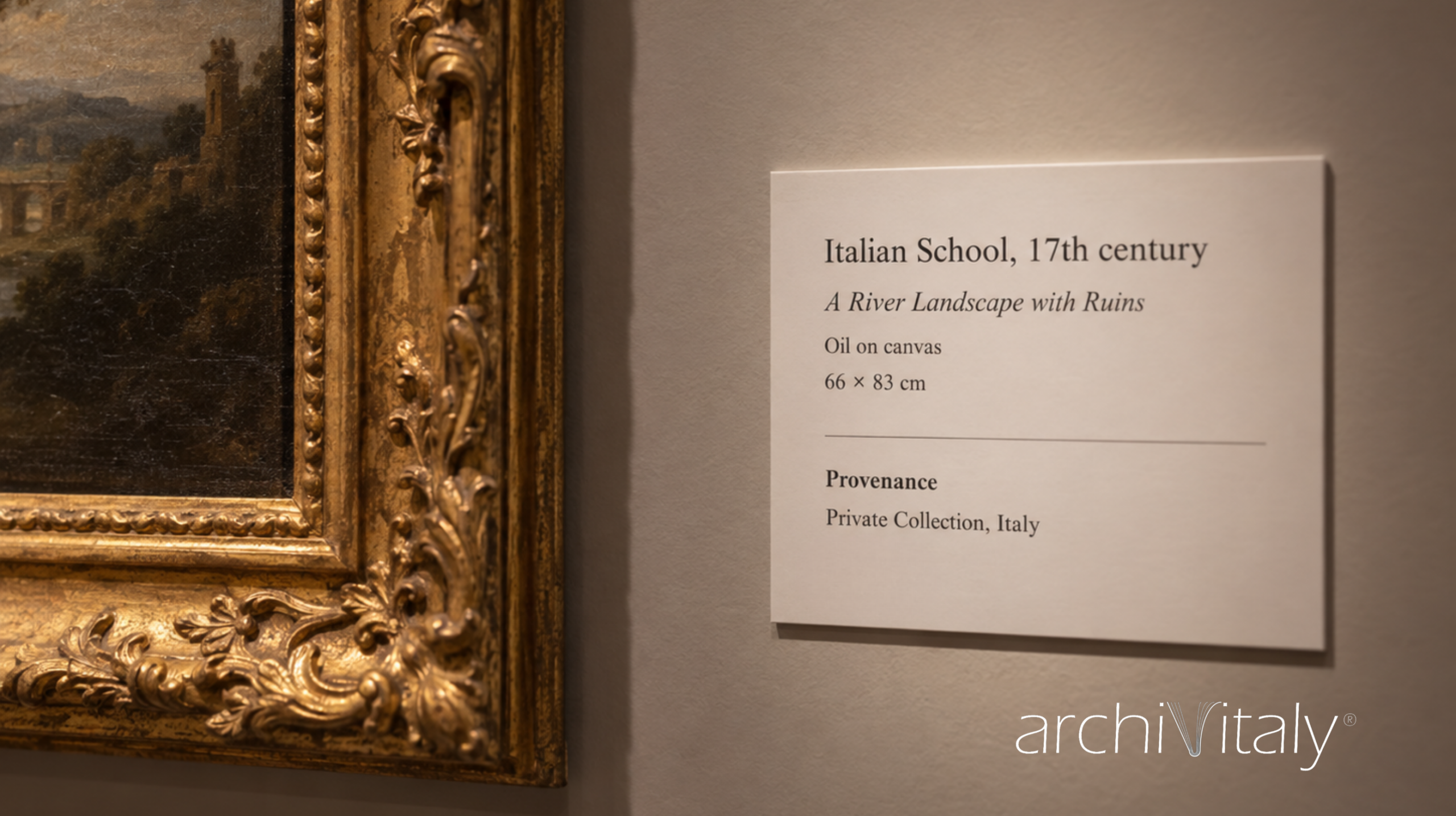
The formula Private Collection, Italy is so familiar within the language of the art market that it can pass almost unnoticed. It appears in auction catalogues, dealers’ records, collection histories and successive descriptions of objects whose earlier ownership is either incompletely known or only partially disclosed; alongside expressions such as by descent, European private collection, acquired in Italy or property of a gentleman, it belongs to a vocabulary through which complex histories of ownership are routinely compressed into short, apparently intelligible statements. There is, in itself, nothing inherently problematic about such formulations. A private owner may have good reasons to remain anonymous; a consignor’s identity may be known to those responsible for a sale but withheld from publication; an object may have remained within a family for several generations without leaving the documentary traces associated with institutional collections, public exhibitions, or major transactions. The difficulty begins elsewhere: not with the legitimacy of anonymity, nor even with the brevity of the published description, but with the evidential ambiguity that brevity can conceal. A statement such as Private Collection, Italy may correspond to a well-documented episode in an object’s history, supported by inventories, photographs, correspondence, invoices or other contemporary records; it may equally represent information supplied by a present or former owner, inherited through family recollection, reproduced from an earlier sale, or preserved in a form whose original documentary basis can no longer readily be established. The wording does not let the reader distinguish between these possibilities. It therefore tells us something about the provenance being asserted, but considerably less about the evidential foundations upon which that assertion rests. This distinction is vital, because a published provenance and a documented provenance are not quite the same thing.
Provenance as statement and provenance as evidence
The conventional form of a provenance encourages a particular kind of reading. Names, places and dates appear sequentially; ownership passes, apparently smoothly, from one collection to another; gaps are reduced typographically to a line, a question mark, or the absence of a date. The resulting chronology may be concise and useful, but concision necessarily suppresses much of the apparatus through which the chronology was constructed. Two consecutive entries can therefore possess very different evidential status whilst appearing, on the page, to carry equivalent weight: one may be established by a contemporary inventory in which the object can be identified with considerable confidence; another may derive from a later catalogue whose author reproduced information supplied by a previous owner; a third may depend upon a photograph, an inscription, an old label or a correspondence file; a fourth may simply repeat the provenance given in an earlier sale catalogue without identifying the evidence upon which that earlier catalogue itself relied. The distinction is not merely terminological. Indeed, provenance research depends upon the relationship between a historical proposition and the evidence capable of sustaining it; a provenance entry, by contrast, is the condensed expression of the proposition after that relationship has already been interpreted, simplified and, in many cases, stripped of its qualifications. For this reason, the statement that an object belonged to a ‘private collection in Italy’ cannot be evaluated solely by asking whether the phrase has previously appeared in print. The more consequential question is how that information entered the documentary record in the first place.


