

The study of early modern Italian abbreviations has inevitably been shaped by the practical usefulness of repertories. A reader confronted with an unfamiliar mark wants to know how it should be expanded, and collections of abbreviated forms, whether historical or modern, provide an indispensable point of reference; their usefulness can nevertheless encourage a misleading conception of the material, since the very act of arranging abbreviations alphabetically or typologically tends to detach them from the circumstances in which they were written. An abbreviation does not operate independently of a hand, a language, a documentary genre, or an institutional environment, nor did the Italian peninsula constitute a single scribal territory within which graphic conventions were distributed uniformly. Forms circulated; some enjoyed very wide currency, particularly where Latin, notarial practice, ecclesiastical administration, or chancery traditions created common professional habits, while others were more restricted. Even where the signs themselves were familiar, however, their frequency, execution, and range of possible expansions could be conditioned by the education of the writer, the formulae proper to a particular type of document, and the expectations of those for whom it was produced. The geographical question is therefore real, but easily overstated. A Tuscan document cannot safely be approached on the assumption that every convention encountered in a Venetian one will function identically, still less can an Italian example be transferred without qualification to French, Iberian, German, or English material; yet an equally crude distortion arises when “Tuscan”, “Venetian”, or “Roman” practice is treated as though each described a coherent local system. The surviving manuscripts themselves make such neat classifications difficult to sustain. Within a single city one finds different professional cultures of writing; within a single institution, writers of different training and ability; occasionally, within a single page, neighbouring hands that abbreviate in noticeably different ways. Regional convention belongs to the explanation, but it is only one layer of it.
The limits of locality
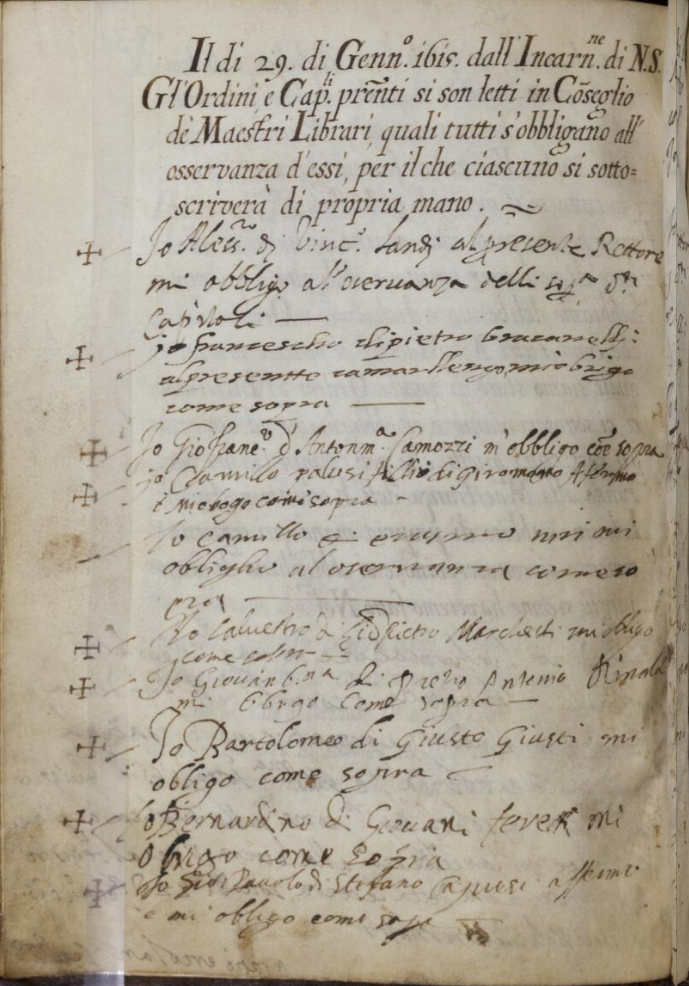
Fig. 1: Newberry Library, complete digitisation of Case Wing MS Z 46735 .916; open f. 23v. Members of the Sienese Guild of Stationers and Booksellers subscribed to the same statutes on this folio; the neighbouring hands reveal noticeable differences in the frequency and use of abbreviations. Credit: Newberry Library, Chicago, VAULT Case Wing MS Z 46735 .916, f. 23v. From the Newberry Library. The Newberry record identifies the item as “No Copyright – United States” and permits reuse under its open-access policy.
The 1615 statutes of the Sienese Guild of Stationers and Booksellers provide an unusually concentrated example because they bring several writers into immediate physical proximity. Commissioned as a formal copy of the revised statutes of the Arte dei Cartai e Librai, the manuscript contains, towards its end, leaves reserved for the matriculation of guild members, each of whom confirmed his adherence to the statutes by adding his own subscription. Folio 23v consequently preserves a formal administrative passage followed by the hands of men who belonged to the same professional association and were writing for essentially the same purpose. The introductory text contains such forms as genn(ai)o, Incarn(azio)ne, N(ostro) S(ignore), cap(ito)li, pre(se)nti, and co(n)seglio; beneath it, Alessandro Landi signs himself Aless(and)ro di Vinc(enz)o Landi and employs further contractions including p(r)esente, sop(r)a, and d(ett)i. These readings can be checked against the project’s transcription of folio 23v. Other members abbreviate differently and, in several instances, less extensively. The palaeographical description of the manuscript is explicit on this point: the hands all belong broadly within the italica tradition, but their levels of execution vary, and Landi is singled out for a degree of graphic competence visible, among other features, in his greater use of abbreviations.
The evidential value of the page lies less in any individual abbreviation, most of which presents no exceptional difficulty, than in the scale at which variation becomes visible. Siena supplies a common civic and institutional setting, the guild a common professional environment, and the act of subscription a common documentary purpose; none of these produces graphic uniformity. It would be excessive to infer from one folio that abbreviation was principally an individual matter, since the shared conventions remain obvious, but the reverse inference is equally untenable: local convention does not determine each writer’s practice. The repertory available to a Sienese writer could be common while its actual deployment remained selective, dependent upon education, familiarity, and habit. For the modern reader, this has a practical consequence. An abbreviation encountered elsewhere in the volume should not be interpreted merely because a comparable sign occurs in another Sienese document; the strongest comparanda are normally those generated by the writer under examination, followed by other hands working within the same documentary environment, before the comparison is widened to regional or supra-regional material.
Venice: one city, several documentary cultures
The difficulty of attaching abbreviation too securely to place becomes still clearer in late sixteenth-century Venice, where two roughly contemporary manuscripts preserve markedly different forms of professional writing. A notarial certificate issued in 1581 by Marcus Antonius de Cavaneis, concerning the legitimation of Marco Negroponte, is written in an italica described by the palaeographer Maddalena Signorini as particularly dense in technical abbreviations. The opening dating clause already presents Mill(esi)mo, Quin(qua)g(esi)mo, and m(ens)is; legal and professional language introduces forms such as Mag(nifi)co, nod(ar)o, liberam(en)te, p(er), and instr(ument)o. The forms can be followed directly in the project’s transcription of the Negroponte certificate. The density is not incidental. Notarial prose was generated within a professional culture in which formulaic recurrence, technical terminology, and long-established Latin conventions made extensive abbreviation economical without making the text obscure to its intended readers.
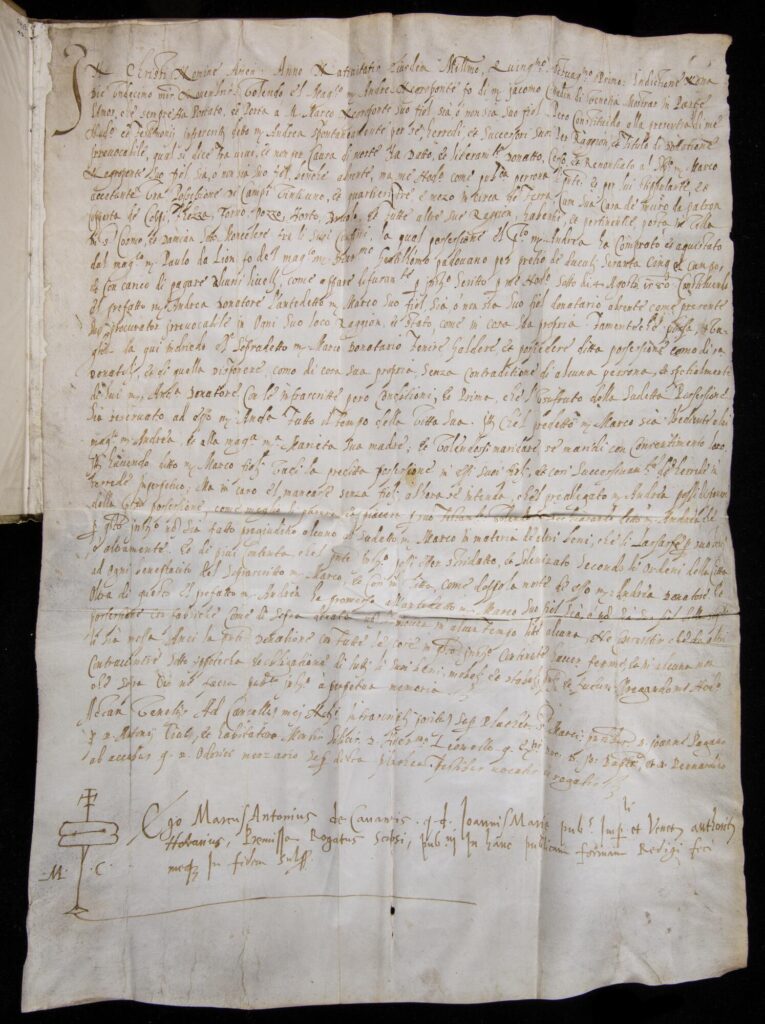
Fig. 2: Opening section of the folded notarial certificate concerning the legitimation of Marco Negroponte, issued in Venice in 1581; the document contains a high density of technical abbreviations in vernacular and Latin notarial formulae.
Credit: Newberry Library, Chicago, Wing MS ZW 1 .581, folded notarial certificate concerning the legitimation of Marco Negroponte, 1581. From the Newberry Library.
A Venetian ducale of approximately 1570 offers a useful counterweight precisely because little geographical distance separates the two documents. Issued in connection with the office of Procurator of St Mark’s and copied in a fine chancery cursive, it belongs not to private notarial practice but to the administrative culture of the Republic. Its text also abounds in abbreviation: n(ost)ri, co(m)mun, accioch(e), sara(n)no, s(er), Lio(n), butta(n)do, Coll(egi)o, and Cap(itolo) occur in the transcribed folios 65v–66r, yet they inhabit a page whose graphic discipline, textual organisation, and institutional purpose differ substantially from those of Cavaneis’s certificate. The script itself retains elements of Gothic formation within an otherwise Italian chancery hand, while the manuscript’s elaboration, rubrication, and ceremonial presentation place it within a documentary economy quite unlike that of the folded notarial instrument.
The comparison is more revealing than a simple opposition between Venice and Florence would have been. A researcher who speaks of “Venetian abbreviations” is not necessarily wrong; some habits were undoubtedly local, and the institutional continuity of Venetian government fostered recognisable documentary conventions. The category becomes misleading only when locality is allowed to absorb the other variables. Cavaneis wrote as a notary, within the linguistic and formulaic expectations of a legal instrument; the scribe of the ducale wrote within a chancery tradition whose conventions were formed by another administrative purpose and another readership. Their shared city does not erase those distinctions. Nor, conversely, should the presence of a familiar abbreviation in both documents persuade us that every superficially similar mark must receive the same expansion. The graphic sign supplies part of the evidence; syntax, recurrent formulae, professional vocabulary, and the writer’s own practice supply the rest.
Individual usage and professional script in Florence
The Florentine material allows the comparison to be extended without turning it into a catalogue of regional peculiarities. Michelangelo’s letter of 25–26 January 1545 to Salvestro da Montauto and his associates, concerning payment to Raffaello da Montelupo for work connected with the tomb of Julius II, is an autograph document written in the artist’s characteristic italica. Its purpose is practical, indeed financial, and its abbreviations occur with complete naturalness: Mag(nifi)ci, mo(n)te, co(m)pagni, p(er), pagame(n)to, Mo(n)telupo, secta(n)to, ave(n)dole, op(er)a, sa(n) Piero, i(n) Vi(n)cola, and conte(n)ti appear within a short text whose meaning would have presented no special obstacle to its intended recipients. The entire passage can be checked in the transcription of Michelangelo’s letter. The abbreviated forms are not the specialised apparatus of a notarial office, although some of the devices themselves belong to conventions of very wide circulation; they form part of Michelangelo’s ordinary practical handwriting and recur sufficiently often to make his habits visible within the compass of a single page.
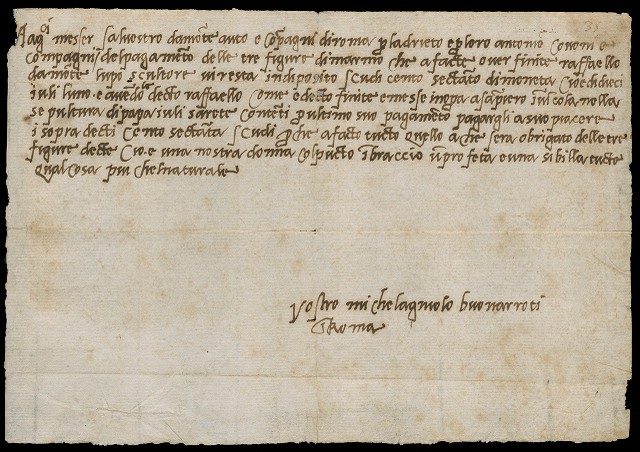
Fig. 3: Michelangelo’s autograph letter of 1545 uses abbreviated forms throughout a practical communication concerning payment, showing that abbreviation was by no means confined to notarial or chancery writing. Credit: Newberry Library, Chicago, VAULT Case Wing MS ZW 535 .B943. From the Newberry Library.
A professional copy of the statutes of the Florentine Mercanzia, produced around 1580, presents another Florentine context while altering nearly every other relevant condition. The manuscript was probably prepared for practical consultation by officers of the Mercanzia and judges of its commercial court; its hand is regular, professional, and moderately cursive, and the opening folio contains such forms as Ser(enissi)mo, Sig(no)re, d(e)lla, repeated p(er), op(e)re, and grandem(en)te. These forms appear in the project’s transcription of folio 1r. The contrast with Michelangelo’s letter is instructive not because one set of forms is “more Florentine” than the other, but because the same urban and linguistic environment accommodates a personal autograph, composed for a specific transaction, and a carefully produced institutional text intended for repeated administrative use.
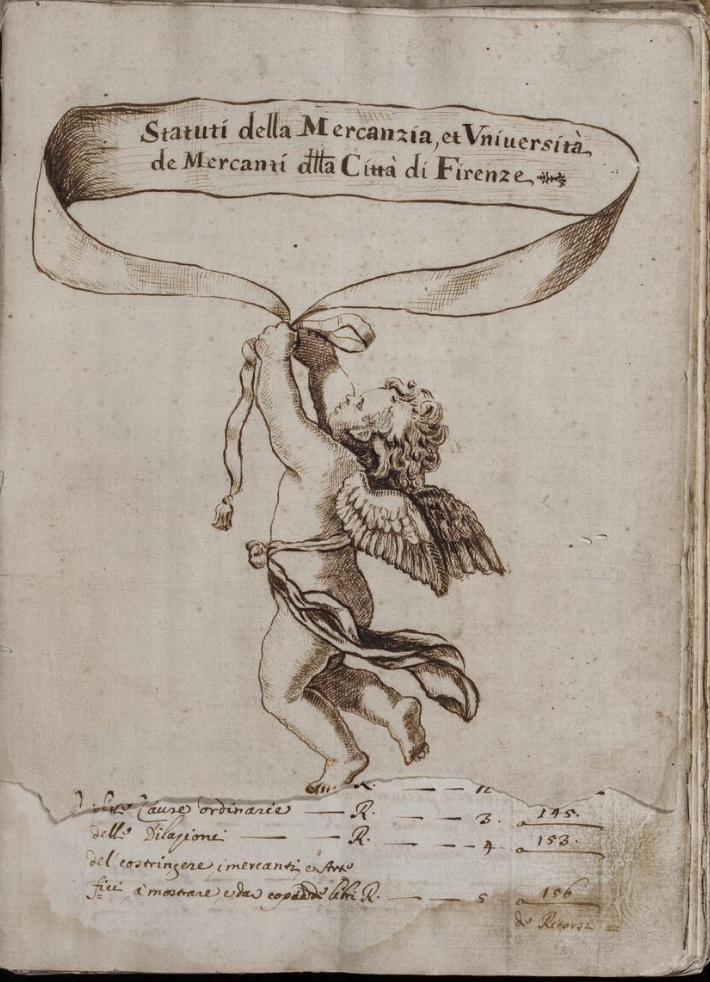
Fig. 4: Frontispiece of a professional copy of the statutes of the Florentine Mercanzia, c. 1580; the manuscript reflects the formal documentary culture of one of Florence’s principal commercial institutions. Credit: Newberry Library, Chicago, VAULT Case MS folio H 5435 .312, f. 1r. From the Newberry Library. The digitised manuscript is listed as “No Copyright – United States”.
The juxtaposition also helps to clarify why the language of “systems” requires some care. Early modern abbreviation was systematic in the sense that writers operated within historically intelligible conventions rather than inventing arbitrary private codes; it does not follow that those conventions formed closed or geographically self-contained systems. Certain methods of contraction and suspension crossed regions, languages, and professions; others acquired particular frequency within specific documentary traditions. A writer might also combine widely shared devices with habits peculiar to his own hand. Consequently, the identification of a sign is only one stage in establishing an expansion: the reader must still determine how that sign functions in the particular lexical and syntactical environment in which it occurs, and whether the same writer uses it consistently elsewhere.
From manuscript sign to editorial expansion
Modern transcription can conceal this layered process because a resolved abbreviation, once printed as a complete word, appears more determinate than the manuscript from which it was derived. The Italian Paleography transcription standards used for the examples above make the intervention visible by placing supplied letters in round brackets: co(n), p(er), pagame(n)to. The project states explicitly that abbreviated letters are expanded in round parentheses, while question marks and square brackets are reserved for other types of uncertainty or loss. The notation is elementary, but the principle behind it is not. Every expansion adds letters that the manuscript does not present in full; where the form is conventional, its recurrence abundant, and the grammatical construction unambiguous, the editorial judgement may be so secure that little discussion is required, whereas a personal name, office, toponym, monetary term, or unusual technical expression may demand considerably more restraint.
Reference works enter most profitably at this stage, as instruments of comparison rather than machines for producing readings. A repertory may establish that a particular mark was conventionally used for a given sequence of letters, or that several expansions were historically possible; it cannot determine, without reference to the manuscript, which possibility is active in a particular occurrence. The hierarchy of evidence is therefore necessarily local before it becomes comparative. Repetition within the same hand is usually more probative than resemblance to a remote example; a recurrent documentary formula may constrain an expansion more securely than the abstract shape of the abbreviation; morphology and syntax can exclude readings that remain graphically conceivable. Institutional and regional analogies become most useful once this internal evidence has been assembled, since they can then confirm, refine, or occasionally unsettle a reading derived from the document itself. The same caution becomes still more necessary when comparison extends beyond the Italian peninsula. Medieval and early modern scribal culture was never confined by modern national boundaries, and Latin in particular carried conventions across very large areas; nevertheless, circulation should not be confused with identity. A sign familiar from an Italian notarial instrument may have close analogues elsewhere in Europe while differing in frequency, lexical range, or execution, just as an apparently identical contraction may operate differently when transferred from Latin into a vernacular text. The historical movement of scribes, texts, administrative practices, and educational models produced overlapping traditions rather than a universal code.
Early modern Italian abbreviations should therefore be approached neither as isolated puzzles nor as entries in a stable national lexicon. Their interpretation depends upon a series of progressively broader contexts: the individual hand, the immediate passage, the document, the documentary genre, the institution within which the text was produced, the linguistic environment, and finally the wider regional or transregional conventions against which the form can be compared. The order is significant. Beginning with a repertory and working backwards towards the manuscript invites a familiar sign to dictate the reading; beginning with the manuscript allows the repertory to perform the more limited, and more useful, task for which it is best suited. The Sienese subscriptions make the point with unusual economy. Men belonging to the same guild, writing one beneath another on the same folio, do not abbreviate identically; contemporary Venetian documents show further differences when notarial and chancery practice are set beside one another; Florentine evidence, in turn, places an individual autograph next to a professional institutional copy without producing anything that could plausibly be described as a single Florentine code. Geography remains part of the history of these forms, but it cannot bear the explanatory weight sometimes assigned to it. An abbreviation acquires its evidential value from the writing culture in which it occurs, and the task of the palaeographer is not merely to recognise a conventional mark, but to establish how securely its expansion can be justified in that particular place on that particular page.


