
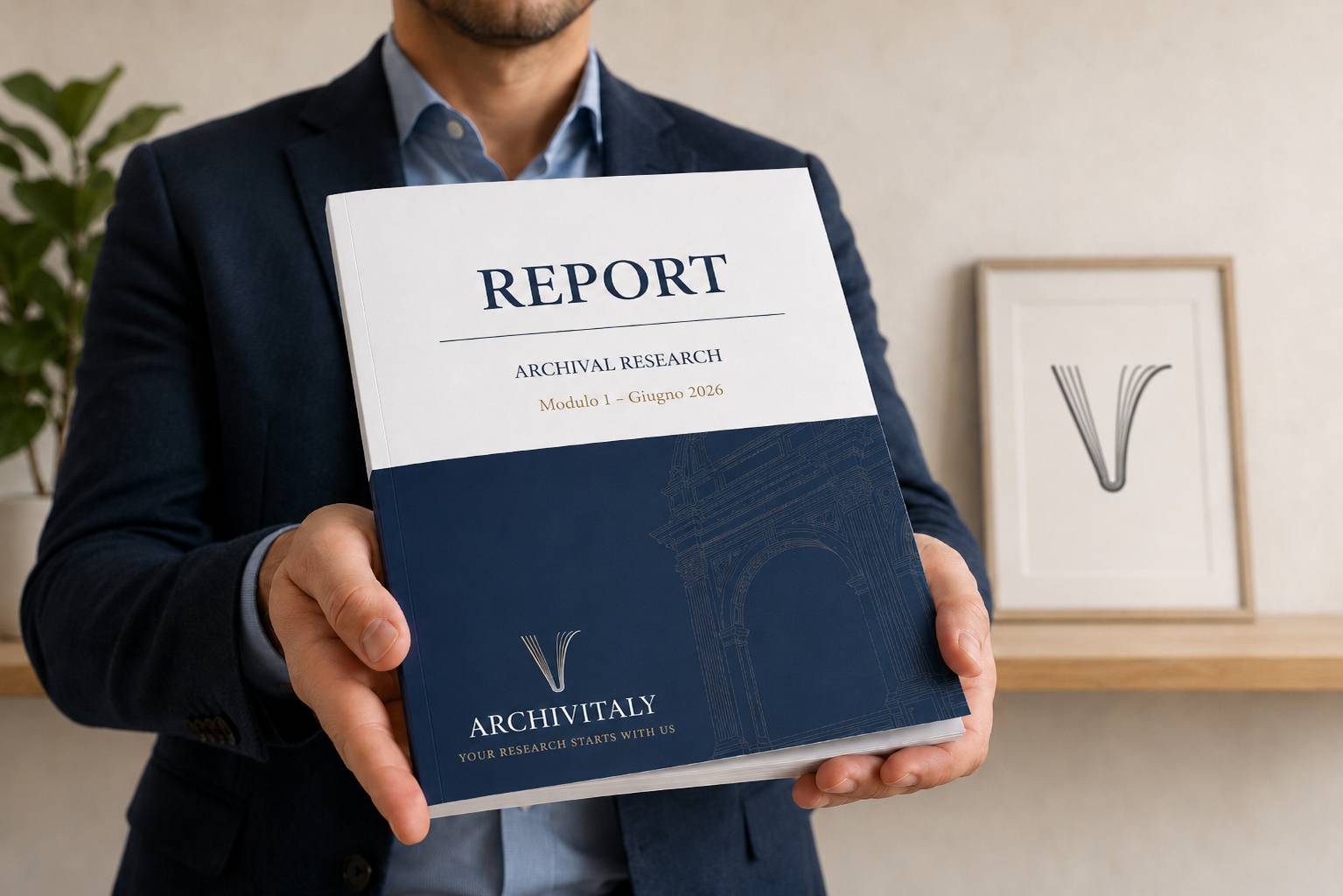
A professionalarchival research report is not a decorative appendix to archival work. It is the form in which research becomes verifiable. Without it, a consultation may produce notes, images, impressions, and useful fragments, but it does not yet produce a stable evidential record. The report is the point at which archival labour is translated into something that can be checked, cited, interpreted, continued, or responsibly questioned. This matters especially in historical, provenance, legal-historical, and art-historical research, where the value of a result rarely lies in a single document alone. A source may confirm a date, weaken an attribution, identify a person, exclude a proposed ownership trail, or show that a promising line of enquiry is unlikely to proceed. None of these outcomes is self-explanatory. Their meaning depends on where the source was found, how it was identified, what was searched before it, what was not available, and what limits remain. A good report therefore does more than say what was found. It explains the research path by which the finding was reached.
A report should preserve the research question
The first function of a professional research report is to restate the question in a form that can be tested. Many archival enquiries begin with broad or unstable formulations: a partial citation, a provenance claim, a name attached to an object, a reference copied from an older publication, or a suspicion that a document may survive somewhere in Italy. The report should not simply repeat this uncertainty. It should show how the question was translated into an operational search. That means defining the chronological range, the names and variants searched, the institutions or fonds prioritised, and the type of evidence considered relevant. In some cases, the initial question may prove too broad and need to be narrowed. In others, the archive itself may force a methodological adjustment because a fonds is closed, an inventory is incomplete, or an expected series does not contain the kind of material implied by the brief. This opening section is not bureaucracy. It is the safeguard against retrospective confusion. Six months later, when a client, scholar, curator, lawyer, or researcher returns to the file, it should still be clear what was being tested and why.
It should distinguish activity from evidence
One of the most common weaknesses in archival reporting is the confusion between work performed and evidence obtained. A list of archive visits, catalogue searches, emails sent, or volumes requested is useful, but it is not enough. Activity explains effort; evidence explains meaning. A professional report needs both. The diary of work records what was done, when, and under what conditions. It may include archive appointments, consultation requests, retrieval limits, closed collections, online catalogue checks, correspondence with institutions, and material postponed to a later phase. This creates transparency around the labour involved and helps explain why certain results could or could not be obtained within a given module. The evidential section, however, must go further. It should identify the sources that matter, summarise their content, assess their relevance, and explain how they affect the research question. A document is not useful simply because it contains a familiar name. It may be useful because it places that name in a specific legal, administrative, artistic, material, or geographic context. Equally, a source may be significant because it does not contain what one would expect to find there. A professional report should make that distinction legible.
Complete references are non-negotiable
Archival evidence cannot be evaluated without complete references. A vague description such as “notarial register in Rome” or “file on the estate” is not a citation. It may remind the researcher what was seen, but it does not allow another person to locate, verify, or reuse the source. A professional research report should provide the full archival reference in a coherent form: institution, fonds, series or subseries where applicable, unit, file, folio, page, or item number when relevant. The exact level of detail will vary according to the archive and the structure of the collection, but the principle is constant. The reference must lead back to the source. This is why reporting is closely connected to archival method. The Italian Sistema Archivistico Nazionale describes the historical method as grounded in respect for the principle of provenance, by which archival material is understood through the order and context of the fonds to which it belongs. In practical reporting terms, this means that a document should not be detached from the archival structure in which it was found. The same principle applies to internal research photographs. Image files should not float separately from the report. They should be named, ordered, and linked to the relevant source entry, so that a reader can move from the report to the image and from the image back to the shelfmark. Without this connection, documentation becomes accumulation rather than evidence.
The report should include negative results
Negative findings are often misunderstood by clients, and sometimes underreported by researchers. Yet in professional archival work, a negative result can be highly valuable. It may show that a person does not appear in a relevant index, that a property is absent from a register where it was expected, that a cited document is not preserved under the reported shelfmark, or that a collection does not contain the category of material suggested by secondary literature. Such findings do not necessarily prove absence in an absolute sense. They do, however, define the limits of the search already conducted. This prevents unnecessary repetition, helps refine the next stage of work, and protects the client from paying again for the same unproductive path. The key is to report negative evidence precisely. “Nothing found” is rarely sufficient. A professional report should explain what was checked, what criterion was used, what the source did contain, and why the result is negative or not directly pertinent. The absence of evidence becomes useful only when the scope of the search is clear. This is also where professional caution matters. A negative finding in one source does not automatically close the question. It may simply redirect it.
Interpretation should be separated from verified fact
A strong report does not flatten uncertainty. It distinguishes what is directly documented from what may be inferred, hypothesised, or left open. This distinction is particularly important in provenance research, attribution history, legal-historical work, collections-based research, and enquiries involving fragmented or damaged materials. A verified fact is something that the consulted source directly supports. An interpretation is the meaning assigned to that fact within the wider research question. A hypothesis is a possible explanation that requires further checking. A professional report should not blur these categories, especially when the client may use the findings in a publication, sale file, legal review, catalogue entry, or institutional decision. This does not mean that the report should avoid interpretation. On the contrary, interpretation is often one of the most valuable parts of professional archival work. But it should be disciplined interpretation: grounded in the sources, explicit about limits, and careful not to transform plausibility into certainty. As discussed in Archivitaly’s article on what makes archival research reliable, reliable archival work depends not only on locating material, but on method, supervision, and critical evaluation. Reporting is one of the places where that reliability becomes visible.
Access limits and unresolved questions must be recorded
A research report should also document what could not be done. Archives are not neutral workspaces in which every source can be summoned on demand. Material may be temporarily unavailable, under restoration, uncatalogued, misdescribed, restricted, awaiting authorisation, subject to daily retrieval limits, or accessible only by appointment. These conditions affect the research result and should not disappear from the final account. Recording access limits is not an excuse for incompleteness. It is part of professional transparency. A reader needs to know whether a source was checked and found irrelevant, identified but not yet consulted, or inaccessible during the period covered by the report. Each of these situations has a different evidential value. The same applies to unresolved questions. A good report should end by identifying what remains open, what should be verified next, and which lines of enquiry appear stronger or weaker after the work completed. This is especially important in modular research, where one phase may define the priorities of the next. A professional report should therefore function both as a record of work completed and as a structured foundation for further investigation.
Reporting is part of the research, not an administrative extra
The quality of archival research cannot be judged only by the number of documents found. It must also be judged by the quality of the record left behind. A poor report can make good research difficult to verify. A strong report can make even partial, negative, or uncertain results intellectually useful. For clients, this is essential. It allows them to understand what has been done, what has been found, what has been excluded, what remains uncertain, and what further work would realistically involve. For researchers, it creates continuity. For scholars, editors, curators, and collectors, it provides a basis for citation, interpretation, and due diligence. A professional research report should therefore include a clear research question, a record of activities, full archival references, concise source summaries, linked photographic documentation where permitted, negative results, interpretive cautions, access limits, and proposed next steps. But its deeper purpose is more important than any list of components: it makes the research accountable. Without that accountability, archival work remains a private process; with it, the work becomes evidence.


