
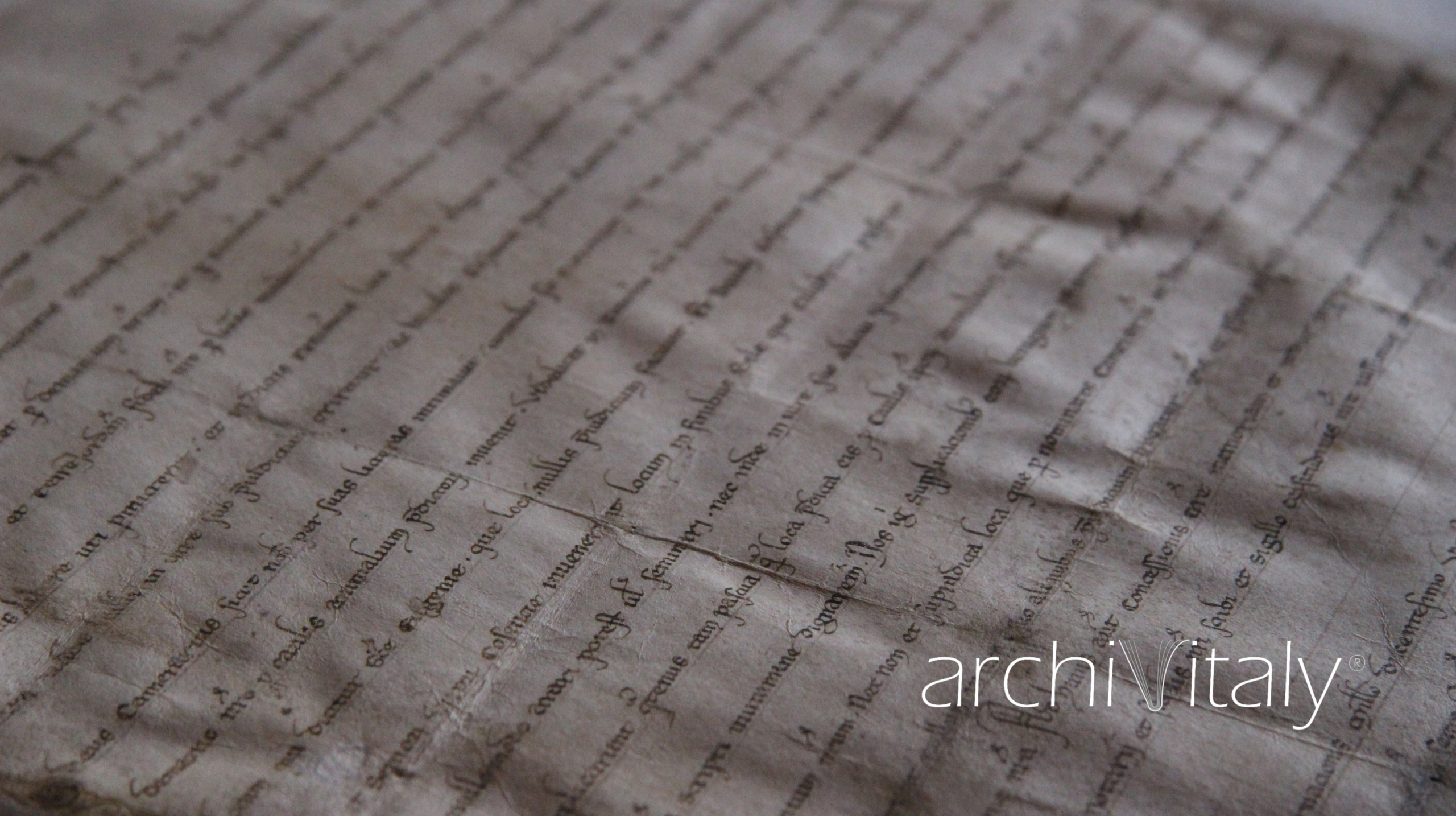
Dating early modern hands is an exercise in historical argument, not in visual recognition. An undated page does not disclose its chronology through a single diagnostic letter, an unfamiliar abbreviation, or a general impression of antiquity. Its date must instead be approached through the convergence of graphic evidence: the forms of individual letters, their proportions, the rhythm and speed of execution, the relations created between one letter and the next, the conventions of abbreviation, and, no less importantly, the documentary circumstances in which the writing was produced. Italian palaeographical scholarship has long approached handwriting through a precise set of graphic criteria: the shape and proportions of individual letters, the ductus or manner of execution, the angle of writing, and the relationships established between letters within the written line. None of these elements constitutes a date in itself. Taken together, however, and compared with securely contextualised material, they begin to situate a hand within a historical culture of writing.
A date is an argument, not a resemblance
There is an understandable temptation, particularly when working quickly through archival material, to date a hand by resemblance. One recognises a looped d, an elongated ascender or a characteristic g and associates it with examples encountered elsewhere. Such recognition is not valueless; visual memory is an important component of palaeographical expertise. But resemblance becomes chronological evidence only when the feature in question can itself be situated within a documented history of use. A letterform is significant for dating not simply because it appears familiar, but because its occurrence, persistence and distribution can be assessed across securely dated examples. This is precisely where caution is required. Writers did not abandon one form at the beginning of a new decade, nor did chancery offices, notaries, households and commercial environments adopt graphic innovations simultaneously. Habits acquired in youth might persist for decades; institutional scripts could remain markedly conservative; and the same writer might employ different degrees of formality in a legal instrument and a private memorandum while retaining recognisably personal habits in both. This is also why the modern Italian palaeographical tradition has resisted treating scripts as self-contained sequences of formal types. In the work of Armando Petrucci in particular, the history of writing was brought into sustained relation with the history of society, so that graphic form could be read not only chronologically, but in relation to education, profession, institutional setting and function. This has an immediate consequence for dating. The question is not simply, When does this form occur? It is also, Who was likely to use it, for what purpose, under what conditions, and alongside which other graphic practices?
There was no single ‘early modern Italian hand’
Any attempt to date Italian material must begin by abandoning the notion that early modern Italy possessed a single, progressively evolving national script. What survives instead is a complex ecology of writing traditions, overlapping in chronology while differing in social origin, professional function and degree of formality. From earlier documentary cursives emerged traditions that would include the minuscola cancelleresca and the mercantesca, the former closely associated with notarial and educated professional environments, the latter developing within the writing culture of merchants. The two could coexist while serving substantially different communities and purposes. The humanistic transformation complicated this landscape further. Around the beginning of the fifteenth century, Poggio Bracciolini’s deliberate revival of Caroline models produced what is now termed humanistic minuscule, the script contemporaries understood as antiqua. Niccolò Niccoli, in turn, developed a more cursive humanistic mode in which humanistic and inherited graphic tendencies could coexist. By the early modern period, therefore, one does not encounter a neat chronological sequence in which a new script simply replaces its predecessor. One encounters inheritance, adaptation and coexistence. The palaeographical task is correspondingly more exacting: identifying a broad graphic tradition is the beginning of the chronological enquiry, not its conclusion.
Letterforms matter most when they cease to be isolated
Individual letters remain indispensable evidence. Certain forms of a, d, g, r, s or f may be especially revealing; so may the treatment of ascenders and descenders, the closure or openness of bowls, the proportions between body and shaft, or the recurrent manner in which one letter is joined to another. Yet the diagnostic force of these features lies principally in their combination. A single apparently archaic form proves very little. It may be a residual habit, a formal variant, or merely one of several alternatives available to the writer. A repeated constellation of forms is more persuasive. Stronger still is a constellation that can be related to dated or otherwise well-contextualised material of comparable geographical origin and documentary function. This is where ductus becomes especially important. The finished silhouette of a letter records only the final appearance of an action. Palaeography is also concerned with that action itself: whether the pen moved rapidly or deliberately, whether the script was continuously linked or frequently interrupted, which strokes were extended, which forms were compressed, and how the writer negotiated the line. Two hands may therefore appear superficially alike while having been produced by quite different habits of execution. Conversely, the same writer may produce markedly different-looking texts at different levels of formality while preserving underlying habits of movement. Dating by letterform without attending to ductus risks mistaking appearance for structure.
Abbreviations belong to systems of writing
Abbreviations require still greater caution, because they are unusually seductive evidence. A distinctive contraction or superscript may appear to offer something approaching a chronological fingerprint. Yet abbreviations are not autonomous signs whose meaning and date can be established in isolation. They belong to historically constituted systems of writing, and their evidential value depends upon the language, documentary tradition, scribal environment and habits of the individual writer in which they occur. The scale of that conventional repertoire is made strikingly visible by Adriano Cappelli’s Lexicon Abbreviaturarum, first published in 1899 and still a fundamental point of reference for Latin and Italian abbreviation systems. Cappelli’s repertory is valuable precisely because it demonstrates the extraordinary multiplicity of graphic solutions through which words, syllables and endings could be contracted. It should not, however, be mistaken for a device by which an isolated sign can automatically be assigned a date. The chronological value of an abbreviation lies instead in its distribution and context of use. A particular sign may persist across centuries, while its frequency, combination with other abbreviating practices, or association with a particular script may change. In some writing traditions, abbreviation could itself acquire a characteristic graphic treatment: in the minuscola cancelleresca, for example, even abbreviation signs could assume an ornamental character. This is why repeated practice matters more than the isolated symbol. Patterns within a single hand can establish the writer’s own abbreviating habits; comparison across a documentary series may reveal institutional convention; and securely dated comparanda can then determine whether those habits possess genuine chronological significance. The abbreviation is therefore evidence not because it can be ‘looked up’, but because it can be situated within a historically specific graphic practice. The same caution applies when abbreviation passes into transcription. As discussed in Archivitaly’s earlier distinction between palaeography, transcription and translation, the identification of a graphic sign precedes its editorial expansion: an apparently obvious reading should not be allowed to conceal an uncertainty that remains present in the source.
Documentary function changes the value of graphic evidence
A further complication follows from the fact that scripts do not develop independently of documentary purpose. A notarial act, a merchant’s account book, an official letter, a household inventory and a private memorandum produced in the same city during the same decade need not look alike. The distinction is not merely morphological. These scripts were embedded in different regimes of literacy and documentary production: cancelleresca in notarial and administrative milieus, mercantesca in the practices of merchants, particularly correspondence and account-keeping. Their coexistence therefore cautions against treating graphic form as a straightforward chronological index. A useful palaeographical comparison must consequently control, as far as the surviving evidence allows, not only for date and place but also for documentary environment. Comparing a hurried private letter with an exemplary chancery hand may create apparent chronological differences that are in fact functional ones. Equally, a conservative institutional document may preserve forms long after they have become uncommon in less formal writing. The archive itself consequently forms part of the palaeographical argument. Series, provenance, administrative context and documentary typology are not incidental information surrounding the handwriting; they help determine what kinds of graphic comparison are historically legitimate.
Prescriptive models and archival practice
Early modern writing manuals are indispensable witnesses to the codification of graphic practice, but they must not be read as transparent records of ordinary handwriting. Ludovico degli Arrighi’s La operina da imparare di scrivere littera cancellarescha belongs precisely to this prescriptive tradition. Arrighi, a scriptor in the papal Segreteria dei Brevi, transformed a professional scribal practice into an articulated model capable of being taught, reproduced and disseminated. The relationship between his calligraphic manuals, his professional activity and the chronology of their publication has been examined in detail by Claudia Catalano. That distinction matters for dating. A calligraphic manual establishes that particular forms had become sufficiently coherent, prestigious or teachable to be codified at a given moment; it does not establish either the beginning or the end of their actual use. The graphic repertoire represented in a manual may already have circulated in professional practice before its publication, while the authority of the printed model may subsequently prolong or reshape its use. What a manual dates securely, therefore, is first of all the codification and transmission of a graphic norm, not every manuscript hand that resembles it. Arrighi’s Operina is especially instructive because the survival and transmission of the work itself complicate any simplistic equation between exemplar and date. Catalano’s study revisits its publication history through bibliological evidence supplied by copies preserved in the Biblioteca Casanatense and the Biblioteca Apostolica Vaticana, as well as the subsequent reuse of its calligraphic blocks. Such evidence reminds us that graphic models possess histories of circulation of their own. For palaeographical dating, the consequence is straightforward but important. Resemblance to a dated writing manual can provide a valuable dated point of comparison, particularly when morphology and ductus correspond closely to the model. It cannot, by itself, supply a narrowly defined date for an archival hand. The relevant question is not simply when a form was codified, but how long it remained active, in which environments it circulated, and whether the manuscript under examination reflects the model directly, a related professional tradition, or the longer afterlife of both.
The date of the text is not necessarily the date of the hand
An explicit date is among the most valuable pieces of chronological evidence a document can offer, but only once its relationship to the surviving written witness has been established. A notarial instrument dated 1587 may survive as the original, as a contemporary copy, as a later transcription, or as an entry subsequently incorporated into a register. The palaeographical question is therefore not simply What date does the text contain?, but What, precisely, does that date allow us to date? The distinction is reflected in Italian scholarly practice for the cataloguing of dated manuscripts, where chronological and scribal statements are considered alongside the physical description, subscription formulae, contents and subsequent history of the manuscript. An explicit date is therefore evidence whose relation to the surviving witness must be established; it is not a datum that can simply be transferred to the hand. In archival material the problem can be still more pronounced. The date of the legal or administrative act, the date recorded in its wording, and the date at which the surviving copy was actually written may coincide, but there is no methodological reason to assume that they must. A chronological argument must establish the status of the witness before treating an internal date as evidence for the hand itself. Palaeography is strongest at precisely this point when it ceases to operate in isolation. Paper and watermarks, the position of a document within an archival series, documentary formulae, identifiable office-holders, annotations, changes of hand, bindings and other material evidence may confirm, narrow or challenge the chronology suggested by the script. The object is not to make handwriting answer every chronological question, but to determine exactly what part of the chronological argument it is capable of sustaining.
The discipline of chronological restraint
The quality of a palaeographical date is not measured by the narrowness of the interval proposed. It lies in the correspondence between the precision of the conclusion and the precision of the evidence. A range of several decades may be methodologically stronger than an attribution to a particular year if the latter depends upon features whose chronological distribution cannot be demonstrated with comparable exactitude. This question of evidential reliability lies at the heart of palaeographical method. Paola Supino Martini’s reflections on palaeographical method frame dating and localisation as problems to be approached through comparison, extending wherever possible beyond writing itself to paratextual, textual, codicological and other extra-graphic evidence. The significance of the point is considerable: palaeographical judgement is not made more rigorous by suppressing uncertainty, but by defining it. Securely dated comparanda are indispensable for precisely this reason. The continuing importance of catalogues of dated manuscripts for palaeographical and codicological study rests in large part upon their comparative value. Comparison does not transform dating into a mechanical exercise, but it disciplines judgement by requiring a proposed chronology to be tested against writing whose temporal coordinates are independently established. The distinction matters because palaeographical dates have a tendency to harden as they pass through scholarship. A cautious attribution becomes a catalogue date; the catalogue is cited by a later author; the qualification disappears; and an inference eventually returns as an apparently established fact. Responsible dating should work in the opposite direction, preserving the evidential status of the chronological claim and making visible the degree of confidence on which it rests. A hand, then, does not carry its date in a single flourish, letter or abbreviation. Its chronology emerges from relationships: between morphology and ductus, between abbreviation and linguistic practice, between individual habit and professional formation, between graphic tradition and documentary function, and between the written trace and the material history of the object that preserves it. To date an early modern hand is not to compel it into the smallest possible interval. It is to determine, with as much precision as the evidence warrants and no more, where in historical time that act of writing can responsibly be placed.


