
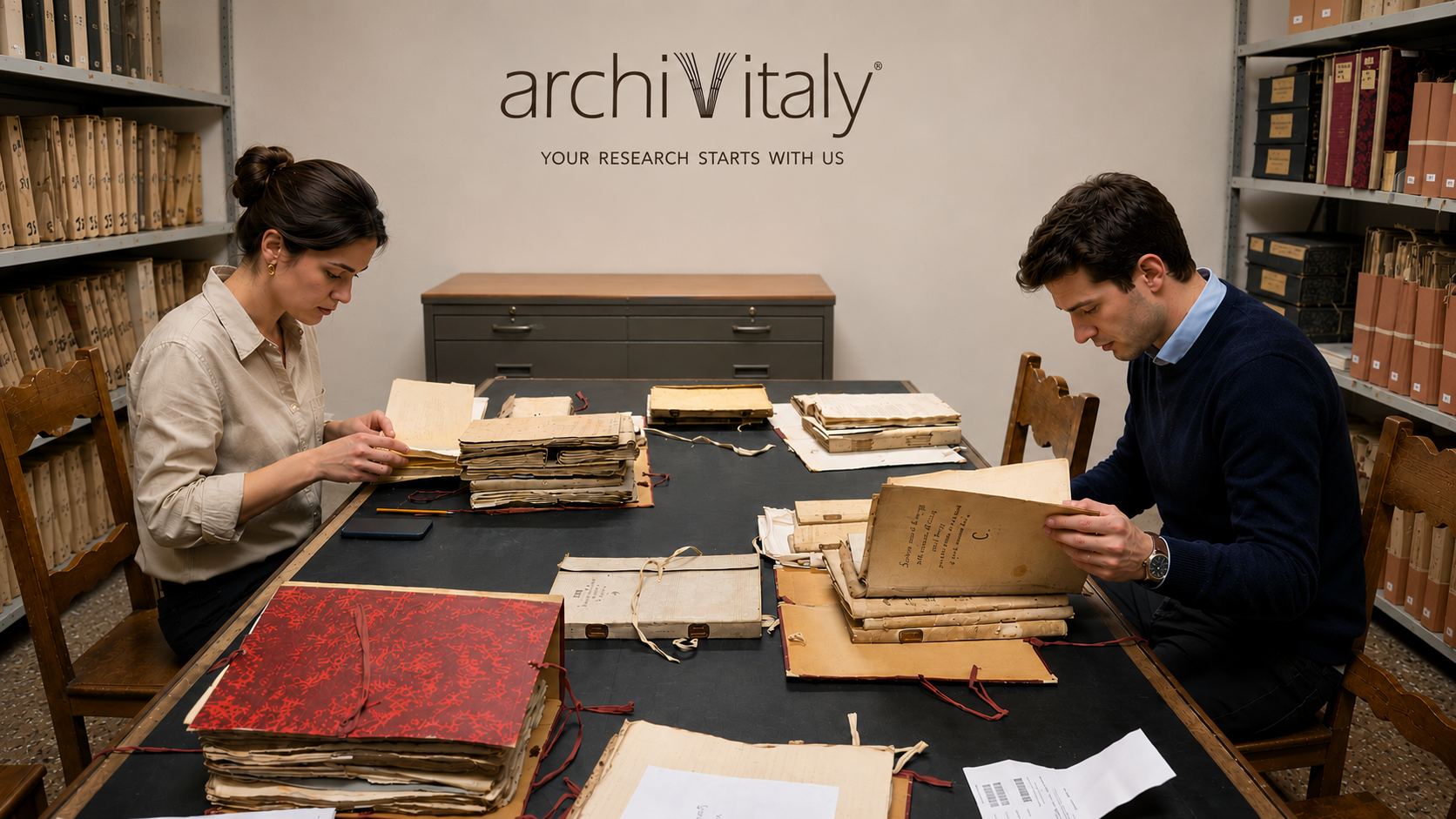
This Italian archives FAQ addresses the practical details most likely to determine whether a planned research day is genuinely productive: opening hours, identification, appointments and document limits. Consultation in an Italian State Archive is free, but every institution applies its own timetable, registration procedure, retrieval schedule and limits on the number of archival units that may be requested. A building may be open while document production has already ended for the day. A reading-room place may be available while the requested material remains subject to advance booking, conservation checks or confirmation by archive staff. For this reason, published opening hours should never be treated as the only information needed to organise a visit.
Are Italian archives open every weekday?
Many Italian State Archives open from Monday to Friday, but there is no single national timetable applicable to every institution. Some reading rooms remain open throughout the afternoon, while others provide extended opening only on selected days. Saturday openings are comparatively uncommon and may be subject to separate arrangements. It is also important to distinguish between the opening hours of the institution, the opening hours of the reading room and the times at which documents are retrieved from storage. At the Archivio di Stato di Benevento, for example, the reading room is open from 8.00 to 16.00, but material is retrieved only at 9.00 and 13.30. A researcher arriving after the final retrieval may therefore be admitted to the room without being able to order new documents. At the Archivio di Stato di Bari, the reading room remains open until 16.00 on Tuesdays and Thursdays, but documents are not retrieved from storage during the afternoon. The apparent duration of the opening day therefore does not correspond to the full period during which new requests can be processed. Institutions may also impose a final admission time before the official closing hour. The Archivio di Stato di Udine currently states that access to its reading room is permitted only until two hours before the institution closes. Its weekly timetable also varies between shorter and longer opening days. Opening hours should therefore be read together with any information headed prese del materiale, distribuzione, ultimo ingresso, modalità di accesso or servizi al pubblico.
Do I need an appointment?
Sometimes. An appointment may be required for the reading-room place, for the documents, for a consultation with an archivist, or for all three. These are separate arrangements and should not be assumed to coincide. At the Archivio di Stato di Asti, consultation in the reading room takes place by prior appointment, arranged by telephone or email, while the Archivio di Stato di Bari requires researchers to book at least one day in advance. The request must include the researcher’s name, telephone number, subject of research, information that may assist in locating the documentation and the preferred date of access. The archive then communicates the first available date. A confirmation that the archive is open is not equivalent to a confirmed booking. Equally, a confirmed seat does not necessarily mean that the documents have been identified, checked and made ready for consultation.
What is Sala Studio?
Sala Studio is the central digital platform developed by the Istituto centrale per gli Archivi to manage services offered by participating State Archives. It is intended to integrate the different stages of archival access and consultation within a centralised online system. Depending on the institution, the platform may be used to register as a reader, request documents for consultation, order reproductions, submit remote research enquiries or arrange an archival consultation. The national information page also states that advance requests may allow the archive to verify whether the desired material is available before the researcher travels. Sala Studio portal may be found here: https://salastudio-archivi.cultura.gov.it
The system entered service in July 2024 at the State Archives of Florence, Milan and Venice, and was subsequently extended to Rome and Novara. Its implementation has continued progressively, so researchers should not assume that every Italian archive uses precisely the same workflow. The national platform provides the technical infrastructure, but local institutional notices remain decisive. They explain when the system becomes operative at a particular archive, which services have migrated to it and whether alternative registration procedures are available.
At the Archivio di Stato dell’Aquila, for example, the portal became operative on 1 July 2026 for registration, reading-room bookings, consultation requests, reproductions, certified digital copies, remote research and archival consultations. Access is available through SPID, CIE or eIDAS, while non-EU citizens and users without a recognised digital identity may register using an email address. At the Archivio di Stato di Udine, online registration through Sala Studio has also been required since 1 July 2026, although the institution continues to recommend arranging an appointment directly with the reading room. This illustrates why the national platform and the local access page must be consulted together.
Which identification documents are accepted?
A valid government-issued identity document is normally required when registering for access. Depending on the institution, accepted documents may include a passport, national identity card or driving licence. The Archivio di Stato di Genova expressly recognises all three and requires users to complete an admission form at least once a year. A new form must also be submitted when the information originally declared changes. At the Archivio di Stato di Benevento, researchers must show an identity document and renew their registration every year and for each new subject of study. Researchers travelling from abroad should ordinarily carry their passport even when another photographic document may be accepted. It provides the clearest form of identification where archive staff must record nationality, place of birth or document details.
Where Sala Studio is in use, the national system is normally accessed using SPID, CIE or eIDAS credentials. Local implementations may nevertheless provide an alternative for researchers who cannot obtain those credentials. L’Aquila, for example, expressly permits email registration for non-EU citizens and users without an accepted digital identity. More information may be found on the national Sala Studio portal here: https://archivi.cultura.gov.it/attivita/strumenti-e-portali/sala-studio
How many documents can I request?
There is no universal daily allowance. Limits may refer to the number of archival units requested in one day, the number delivered at one time, or the number that can remain on deposit for continued consultation. At Benevento, users may request up to ten archival units per day and no more than five at the same time. At the Archivio di Stato di Bari, each researcher may currently consult a total of four archival items, such as boxes, volumes or registers, per day. At the Archivio di Stato di Genova, researchers may request and retain up to four units on deposit but may ordinarily consult only one unit at a time. Material may remain on deposit for up to ten days, subject to possible renewal.
These figures should not be interpreted as measures of documentary volume. An unità archivistica might be a single register, a folder, a bundle or a box containing numerous files. Two units may take several days to examine, while a larger number of concise registers may be assessed comparatively quickly. The daily limit regulates production from storage, not the number of individual pages available to the researcher. Limits can also change because of staff shortages, temporary storage arrangements, conservation work or the distance between the reading room and the repository. A recent local notice therefore takes precedence over a general or older reading-room regulation.
Does a booked reading-room place mean the documents will be ready?
Not necessarily. A seat booking regulates the number of researchers who may enter the room. A document request concerns specific archival material and may require a complete shelfmark, advance notice and confirmation from the institution. Material may be unavailable because it is already in use, undergoing conservation, stored at another site, insufficiently described or temporarily excluded from consultation. Some documentation may be inaccessible because the relevant fonds is still being arranged or inventoried. Digitised material may also be consultable in its original form only after a reasoned request and specific authorisation. The Archivio di Stato di Genova reading-room regulation, for example, distinguishes clearly between admission, the request for an archival unit, its retrieval from storage and its actual availability for consultation. Sala Studio is designed partly to allow requests and material availability to be checked in advance, but the existence of an online submission does not by itself guarantee that every unit can be produced.
This distinction is one of the reasons why apparently straightforward archival projects can slow down. As discussed in Archivitaly’s article on the structural limits affecting research in Italy, access is not a single administrative step but a sequence involving registration, identification, archival description, material requests and institutional confirmation.
Can I order material after arriving?
Often yes, but relying entirely on same-day requests introduces avoidable risk. If the archive operates fixed retrieval rounds, arriving after the final distribution may mean waiting until the next available session or working day. At Benevento, for example, retrieval takes place only at 9.00 and 13.30. At Bari, no new material is retrieved from storage during the afternoon, even on the days when the reading room remains open until 16.00.
If the shelfmark supplied by the researcher is incomplete, additional time may first be needed to consult inventories or obtain assistance from an archivist. Advance ordering is therefore especially advisable where the visit is short, where the material is held off-site, or where the researcher is travelling specifically to consult a limited number of identified units. The request should reproduce the archival reference as accurately as possible, including the institution, fonds, series, unit number and any further elements used in the institution’s finding aids. A title or subject description alone may not allow archive staff to connect the request to an identifiable physical unit.
Can I bring a laptop or photograph documents?
Laptops are generally permitted, although bags, cases and outer clothing may have to be placed in lockers outside the reading room. Individual institutions may impose separate rules concerning pencils, loose sheets, stands, scanners and photographic equipment. At Genova, researchers may bring a laptop without its case, photographic equipment and a mobile telephone, but bags, folders, containers and computer cases must be left in the external storage area.
Photography is governed separately from consultation. At Genova, users may photograph documents for non-commercial study and research purposes with cameras or mobile phones, without flash, lamps or tripods. The archive nevertheless requires the researcher to record the shelfmarks of the photographed documentation. Portable scanners involving direct contact with the archival material are prohibited.
Permission to consult a document should not be interpreted automatically as permission to publish, commercially reproduce or circulate its image. Personal study photographs, reproductions supplied by the institution, certified copies and publication licences are distinct categories and may be governed by different procedures.
What should I verify before travelling?
The safest approach is to consult the institution’s reading-room page, its most recent notices and the specific page concerning registration, booking or document requests. Researchers should establish whether registration is required in advance, which identity credentials are accepted, whether Sala Studio is in use, when the final document retrieval takes place and whether the relevant fonds is subject to restrictions. This check should be repeated shortly before departure. Seasonal hours, local holidays, staffing limitations and technical migrations may be announced after the original visit was planned. The Udine access page, for example, was updated on 14 July 2026 and incorporates procedures introduced only from the beginning of that month.
An email confirmation is particularly valuable where travel, accommodation or a fixed research deadline depends on access to a specific document. The practical sequence is simple but consequential: identify the correct institution, verify the local procedure, register, request the material, obtain confirmation and only then finalise the visit. In archival research, preparation does not replace the work in the reading room. It protects the time available for it.


