
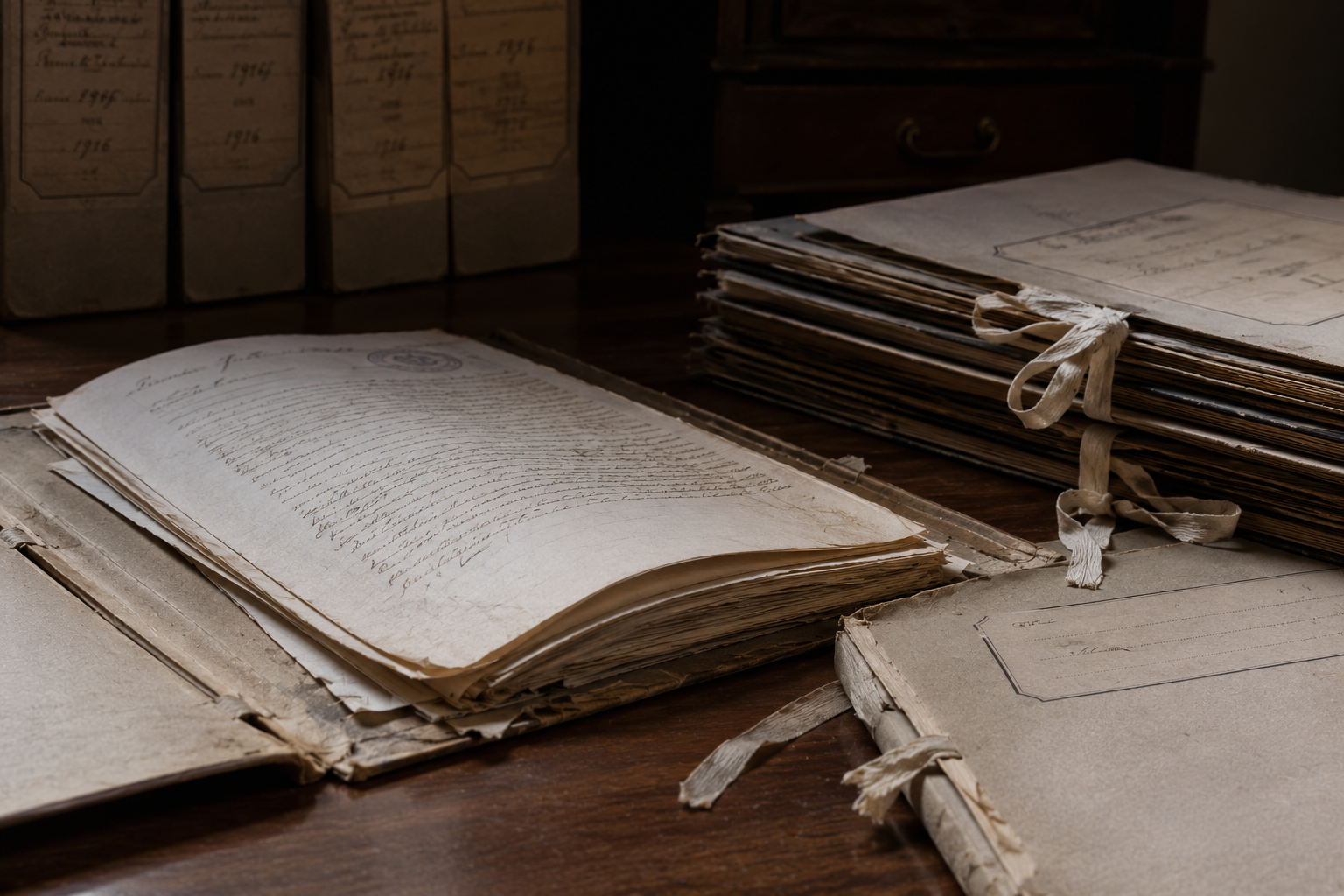
A pre-research brief template is not a bureaucratic prelude to archival work, but one of the instruments that determines whether a project begins with clarity or with avoidable uncertainty. In archival research, the first difficulty is rarely the absence of a document. More often, it is the absence of a sufficiently precise question, chronology, context, or evidential threshold. A strong brief does not guarantee a positive result, and it should never pretend to do so. What it can do is define the problem in a way that makes research testable. It turns a general interest into a structured enquiry, distinguishing what is known, what is assumed, what must be verified, and what would count as meaningful evidence.
Why the brief matters before the archive
Archives rarely respond well to vague questions. A request framed as “I am looking for information about this person” or “I need documents relating to this object” may be understandable at the human level, but it is too imprecise for archival logic. Repositories are organised through fonds, series, shelfmarks, producers, jurisdictions, institutional histories, and historical systems of record-keeping, not through the intuitive categories by which a modern researcher first approaches a subject. In the Italian context, the point is especially clear when consulting national archival portals. The SAN – Strumenti di ricerca online portal brings together inventories and other research tools describing archival fonds preserved in State Archives and in other public and private institutions. This is invaluable, but it also shows why preparation is essential: a finding aid is not a simple keyword engine, and a search term rarely corresponds directly to the historical structure of a fonds, series, producer, or institutional jurisdiction. The pre-research brief therefore sits between the client’s question and the archive’s structure. It translates interest into operational terms. It gives the researcher a controlled starting point, while leaving enough flexibility for unexpected findings, negative evidence, and necessary changes of direction.
From question to research scope
The first task of a brief is to define the research question without inflating it. A useful question is neither too narrow nor too expansive. If it is too narrow, the researcher may miss relevant contextual material; if it is too broad, the research becomes inefficient and difficult to evaluate. A good formulation identifies the object of enquiry, the historical period, the geographical frame, and the kind of evidence being sought. For a provenance project, this may involve a work of art, a former owner, a transaction, an exhibition, a shipment, an inventory, or a family collection. For a historical or bibliographic project, it may involve a person, institution, publication, correspondence network, estate, legal dispute, or manuscript tradition. The crucial point is that the brief should not merely state the desired conclusion. It should define the route by which that conclusion might be tested. “Prove that this painting belonged to X” is not a research brief. “Verify whether documentary evidence survives linking this painting, or a closely identifiable version of it, to the collection of X between these dates” is closer to an archival question.
What the brief should contain
A professional brief should begin with the known facts, separated from hypotheses. Dates, names, places, inscriptions, labels, previous catalogue entries, old references, oral information, and earlier research notes should be presented in a way that makes their status clear. A documented date and a family recollection may both be useful, but they cannot be treated as equivalent evidence. The brief should then set out the chronological and geographical limits of the enquiry. This is especially important in Italian and European archival research, where administrative jurisdictions, family branches, ecclesiastical boundaries, notarial districts, and institutional responsibilities may have changed over time. A city name alone is rarely enough. The relevant archival path may depend on whether the event concerns residence, ownership, legal authority, ecclesiastical administration, taxation, inheritance, trade, or cultural patronage. Names and variants also require careful treatment. Historical documents may record different spellings, titles, patronymics, Latinised forms, married names, noble predicates, professional identifiers, or place-based designations. A brief that records these variants at the outset prevents the researcher from relying on a single modern form that may not appear in the sources at all. Finally, the brief should specify what materials are already available and what the researcher is expected to return. This may include shelfmarks to verify, inventories to consult, scans to review, reference photographs to request where permitted, short abstracts, transcriptions, translations, or a structured report. This is closely connected to the broader question of what makes archival research reliable: reliability depends not only on consultation itself, but on the structure, supervision, and traceability of the research process.
A working model for an archival brief
A concise pre-research brief can be organised around a small number of fields, provided each field is treated with precision rather than filled mechanically. The first field should state the research question in one controlled paragraph. This paragraph should avoid persuasive language and should not assume the conclusion that the research is meant to test. The second field should summarise the factual background. This is where the researcher needs the essential context: who or what is being studied, which dates are secure, which references are uncertain, and what previous work has already been done. The purpose is not to tell the whole story, but to prevent duplication and misdirection. The third field should record names, variants, places, dates, and related entities. This is often where the most useful leads emerge. A former owner, a notary, a palace, a parish, a dealer, an auction, a family branch, or an alternative spelling may become more important than the original search term. The fourth field should define the archival targets, if they are already known. These may be specific repositories, fonds, series, shelfmarks, catalogues, printed inventories, or online databases. Where the archive is not yet known, the brief should say so clearly, rather than presenting a speculative institution as if it were already the correct destination. The fifth field should define the expected output. A project seeking a yes-or-no verification requires a different report from a project intended to build a broader documentary trail. Likewise, a request for reference photographs must take account of each institution’s rules on reproduction, consultation, and reuse.
The value of negative evidence
One of the most frequent weaknesses in poorly framed archival research is the assumption that only positive discoveries matter. In practice, negative evidence can be essential, provided it is properly documented. If a relevant register, inventory, index, catalogue, or archival series has been consulted and contains no pertinent reference, that result may narrow the field and prevent unnecessary repetition. For this reason, the brief should make room for absences, limits, and uncertainty. It should not ask the researcher to force a positive answer from incomplete evidence. A well-conducted search may confirm that a source does not contain the expected information, that a cited shelfmark is incorrect, that a document is temporarily unavailable, or that the surviving material cannot support a stronger claim. This is not a failure of research. It is part of the evidentiary discipline that distinguishes archival work from narrative reconstruction. The archive does not exist to confirm expectations. It provides traces, silences, structures, and constraints, all of which must be interpreted with care.
A brief is not a script
The best pre-research brief is precise, but not rigid. It gives the researcher enough structure to begin intelligently, while allowing the enquiry to respond to the sources. This balance is especially important in complex projects, where the first consultation may reveal that the original path is less promising than an adjacent one. A brief should therefore be treated as a methodological instrument, not as an administrative form. It defines the starting point, the evidential frame, and the limits of the enquiry. It also protects the quality of the final report, because the researcher’s conclusions can be measured against a clearly stated question. In archival work, clarity at the beginning is never cosmetic. It is part of the research itself. The better the brief, the more legible the results become, including when those results are partial, negative, or more complex than expected.


