archivitaly

Your research starts with us

“Private Collection, Italy”: What Does This Provenance Actually Tell Us?

22 Sep 2026

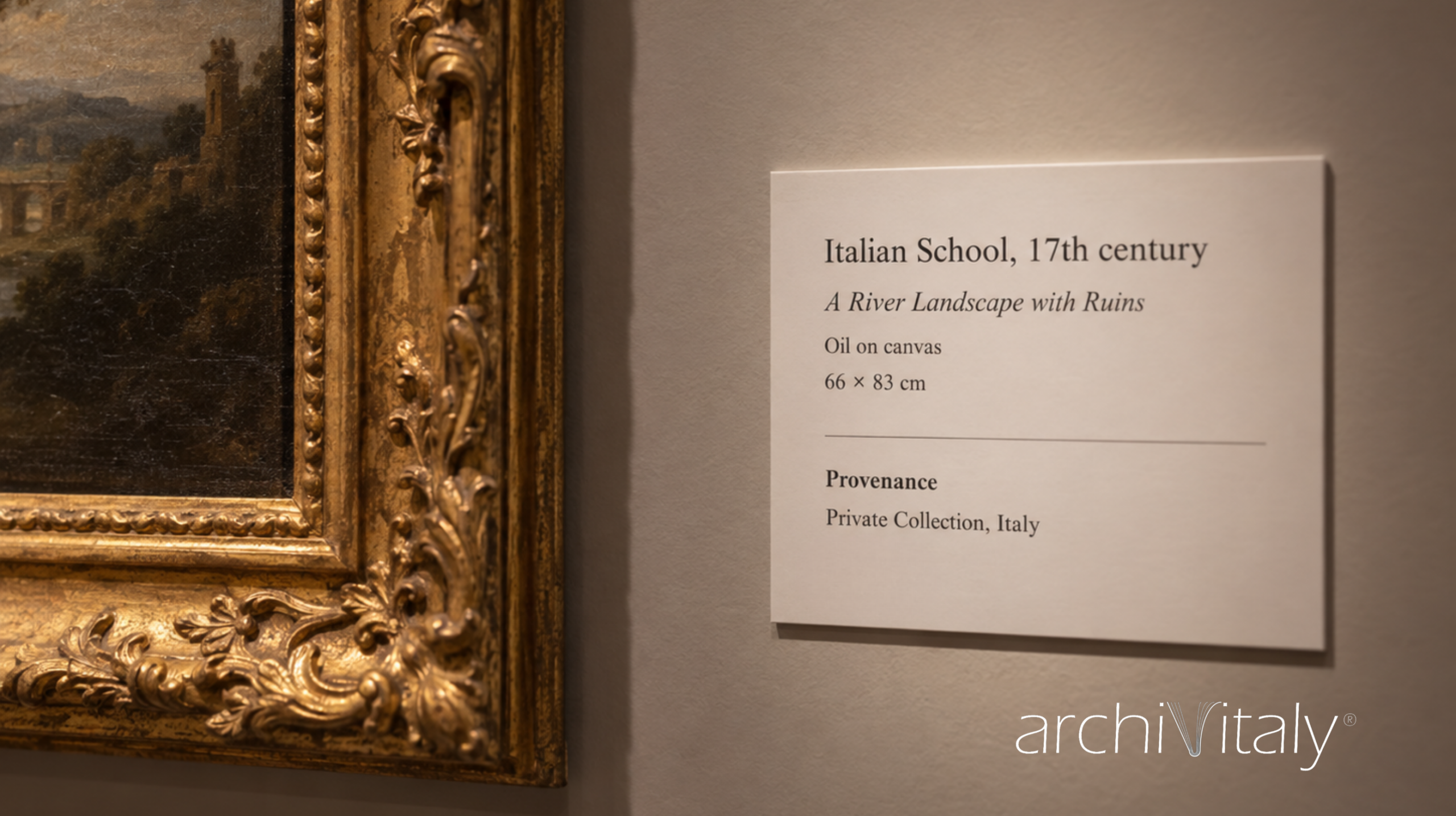
The formula Private Collection, Italy is so familiar within the language of the art market that it can pass almost unnoticed. It appears in auction catalogues, dealers’ records, collection histories and successive descriptions of objects whose earlier ownership is either incompletely known or only partially disclosed; alongside expressions such as by descent, European private collection, acquired in Italy or property of a gentleman, it belongs to a vocabulary through which complex histories of ownership are routinely compressed into short, apparently intelligible statements. There is, in itself, nothing inherently problematic about such formulations. A private owner may have good reasons to remain anonymous; a consignor’s identity may be known to those responsible for a sale but withheld from publication; an object may have remained within a family for several generations without leaving the documentary traces associated with institutional collections, public exhibitions, or major transactions. The difficulty begins elsewhere: not with the legitimacy of anonymity, nor even with the brevity of the published description, but with the evidential ambiguity that brevity can conceal. A statement such as Private Collection, Italy may correspond to a well-documented episode in an object’s history, supported by inventories, photographs, correspondence, invoices or other contemporary records; it may equally represent information supplied by a present or former owner, inherited through family recollection, reproduced from an earlier sale, or preserved in a form whose original documentary basis can no longer readily be established. The wording does not let the reader distinguish between these possibilities. It therefore tells us something about the provenance being asserted, but considerably less about the evidential foundations upon which that assertion rests. This distinction is vital, because a published provenance and a documented provenance are not quite the same thing.


Provenance as statement and provenance as evidence

The conventional form of a provenance encourages a particular kind of reading. Names, places and dates appear sequentially; ownership passes, apparently smoothly, from one collection to another; gaps are reduced typographically to a line, a question mark, or the absence of a date. The resulting chronology may be concise and useful, but concision necessarily suppresses much of the apparatus through which the chronology was constructed. Two consecutive entries can therefore possess very different evidential status whilst appearing, on the page, to carry equivalent weight: one may be established by a contemporary inventory in which the object can be identified with considerable confidence; another may derive from a later catalogue whose author reproduced information supplied by a previous owner; a third may depend upon a photograph, an inscription, an old label or a correspondence file; a fourth may simply repeat the provenance given in an earlier sale catalogue without identifying the evidence upon which that earlier catalogue itself relied. The distinction is not merely terminological. Indeed, provenance research depends upon the relationship between a historical proposition and the evidence capable of sustaining it; a provenance entry, by contrast, is the condensed expression of the proposition after that relationship has already been interpreted, simplified and, in many cases, stripped of its qualifications. For this reason, the statement that an object belonged to a ‘private collection in Italy’ cannot be evaluated solely by asking whether the phrase has previously appeared in print. The more consequential question is how that information entered the documentary record in the first place.

The ambiguity of the private collection

The category ‘private collection’ is particularly instructive because it can describe several quite different states of knowledge. It may refer to an identified individual whose name is withheld from publication; in such a case, anonymity is a matter of disclosure rather than of historical uncertainty. It may refer to a collection whose existence is well attested but whose precise ownership cannot now be reconstructed; alternatively, it may function as a deliberately broad description of information supplied in confidence, or as a conventional shorthand inherited from earlier cataloguing. Adding a geographical designation does not necessarily resolve these ambiguities. Private Collection, Italy appears to locate the object; yet the phrase may describe the owner’s residence, the place at which the object was held, the country from which it was consigned, or simply the degree of geographical specificity available to the person preparing the catalogue entry. Unless the underlying documentation is known, those possibilities cannot safely be collapsed into one another. Again, none of this requires the conclusion that the published information is inaccurate. The more modest, and methodologically more important, conclusion is that the precision of a provenance statement should not be confused with the precision of the evidence behind it. A short formula can conceal excellent documentation; it can also conceal the absence of it.

Repetition and the appearance of corroboration

The problem becomes more interesting once such information begins to circulate. Suppose that an object first appears on the market with the provenance Private Collection, Italy. At a later sale, the earlier catalogue is cited and the same provenance is reproduced; a dealer subsequently lists the object, referring to both sales, and a later catalogue repeats the resulting sequence. Over time, the object acquires an increasingly substantial bibliographical and commercial history: several publications, several transactions, perhaps several entries in databases devoted to auction results or collection history. Yet, the original statement may still derive from a single source. What has multiplied is not necessarily the evidence, but the number of occasions upon which the evidence — or the claim attributed to it — has been repeated. This distinction is elementary in historical method, although it becomes surprisingly easy to overlook once provenance information is presented in cumulative form. Three catalogues reproducing the same earlier statement do not constitute three independent attestations if all three ultimately depend upon the first; the accumulation of references can give an impression of corroboration whilst preserving, unchanged, the evidential weakness or uncertainty of the initial claim. In provenance research, source dependence therefore matters as much as source quantity. A chain of publications may be bibliographically extensive yet evidentially narrow; conversely, a relatively short published provenance may rest upon a substantial body of archival documentation that has never been reproduced in full. The distinction becomes particularly important when a catalogue entry acquires authority simply because it has survived repeated transmission. With time, language that may originally have been tentative, conventional or supplied without documentary citation can harden into an apparently established element of the object’s history.

The auction catalogue as historical source

None of this diminishes the importance of auction catalogues. On the contrary, they are indispensable sources for the reconstruction of ownership, attribution, valuation and circulation; annotated copies can preserve buyers’ names, prices and other information omitted from the printed catalogue, whilst photographs, lot descriptions and measurements may permit identifications that would otherwise be impossible. Their evidential value, however, lies precisely in treating them as historical sources rather than as self-authenticating certificates of everything they contain. An auction catalogue records a particular moment in the life of an object and in the history of the market through which that object passed; it also reflects the information available to the cataloguer, the conventions of the institution or firm responsible for the sale, the degree of research judged proportionate to the lot, the representations made by owners or intermediaries, and the practical limitations within which the catalogue was produced. Consequently, one part of a catalogue entry may be directly observable, another may be supported by contemporary documentation, another may reproduce an earlier publication, and another may depend upon information that cannot be independently assessed by the reader. To regard the entire entry as possessing a single evidential status is to misunderstand the nature of the source. The appropriate response is not suspicion for its own sake; it is source criticism.

Sale history and ownership history

A related difficulty arises from the ease with which recent market history can be mistaken for deeper provenance. An object may be followed with considerable precision through a sequence of sales during the past twenty or thirty years: Milan, London, Paris, perhaps another private collection, then a further auction. Each transaction adds a date, a place, a catalogue reference and, sometimes, a photograph or lot number. The resulting history is detailed and verifiable. What it establishes, however, is principally the object’s recent circulation, it does not necessarily strengthen the evidential basis of an earlier entry such as Private Collection, Italy, by descent, nor does it retrospectively explain the circumstances under which the object entered that collection. A seventeenth-century painting can possess an exemplary market history from 1995 onwards and a remarkably obscure history for the preceding three centuries; an eighteenth-century piece of furniture can be securely identified across several recent sales whilst its earlier ownership remains dependent upon a single uncorroborated assertion. This is not an anomaly. Different parts of an object’s history are documented with different degrees of density, and the documentary abundance generated by the modern market can create a misleading impression of continuity when projected backwards. The distinction becomes still more important when ownership history is conflated with the history of an object’s geographical movement. Evidence that an object was sold outside Italy at a particular date establishes, at most, that it had reached that jurisdiction by then; it does not in itself document when it left Italy, under what legal circumstances it travelled, or whether the surviving provenance contains the records necessary to reconstruct that movement. Sale history, ownership history and export history overlap; they are not synonymous.

The less visible parts of the market

These questions become particularly significant away from the small group of objects whose value, authorship or public profile attracts unusually intensive scrutiny. Much of the trade in historical objects takes place at a different level: paintings of uncertain or changing attribution, furniture, sculpture, decorative arts, works associated with regional schools, objects emerging from family collections, and material whose commercial value may be substantial without placing it amongst the headline lots of the international market. Such works can pass through local and regional sales, dealers and private transactions before reappearing in a different commercial context, sometimes in another country and sometimes under a revised attribution or description. The documentary history generated during this circulation is uneven. A sale catalogue may preserve the only readily accessible photograph of an object at a particular moment; a later dealer may reproduce the earlier provenance; another sale may add a date or remove a qualification. None of these acts is necessarily improper, yet their cumulative effect can be historiographically consequential. For precisely this reason, provenance research should not be reserved conceptually for masterpieces, museum acquisitions or objects already associated with restitution claims. The historical questions raised by the movement of a moderately valued painting or piece of furniture are not rendered methodologically insignificant by its market category. Indeed, the absence of sustained scrutiny at earlier stages of an object’s circulation may make subsequent reconstruction considerably more difficult.

“By descent” and the language of continuity

The formula by descent presents a related, though slightly different, problem. Unlike private collection, it appears to provide not merely a state of ownership but a mechanism of transmission; an object has, apparently, passed from one generation to the next. Yet, the evidential content of the phrase remains indeterminate unless the descent itself can be reconstructed. A documented inheritance, supported by inventories, wills, division agreements or other contemporary records, is not equivalent to a later family recollection that an object ‘has always been in the family’; nor is a continuous family association necessarily the same thing as continuous ownership of the particular object in question. The phrase may be entirely correct in all three cases, but the historical proposition being advanced, and the evidence available to test it, differ considerably. This is particularly important because descent possesses a natural rhetorical plausibility. Long periods without market appearances can readily be explained by inheritance; the explanation may indeed be correct, but plausibility cannot substitute for documentation, especially when the formula is later repeated in successive catalogues until the history it describes appears increasingly secure. The issue is therefore not whether by descent should be trusted or distrusted as a category. It is whether the phrase is being treated as a conclusion whose evidential basis remains open to examination, or as evidence in its own right.

When research makes a provenance less certain

There is a persistent assumption that the purpose of provenance research is to convert incomplete histories into complete ones: gaps are filled, unnamed owners are identified, uncertain dates are narrowed and, eventually, the chronology becomes progressively more continuous. Archival research does not always move in that direction. Consulting the underlying documentation can make a previously confident statement less secure. A name may turn out to have been inferred from circumstantial evidence; two supposedly independent publications may prove to depend upon the same earlier catalogue; an object described as belonging to a particular collection may no longer be securely identifiable once the original inventory is read in context; a precise date may dissolve into a broader chronological range when the documentary basis for it is examined. Such outcomes are not failures of research. They are often evidence that research has succeeded in distinguishing what the sources establish from what subsequent transmission has made them appear to establish. A historically responsible provenance may therefore be less elegant than the one with which the investigation began. It may contain qualifications, uncertain identifications or explicit distinctions between documented ownership and reported ownership; it may retain a question that earlier cataloguing had silently resolved. The gain is not completeness, but accuracy.

What, then, does “Private Collection, Italy” tell us?

The answer depends upon evidence that the phrase itself does not reveal. It may represent a documented collection whose owner has quite properly remained anonymous; it may summarise an ownership history known in considerable detail to those who prepared the catalogue; it may preserve information whose original source is no longer accessible; or it may reproduce a formulation inherited from an earlier publication and never independently re-examined. The wording alone cannot tell us which of these circumstances applies. That limitation matters because provenance statements do not remain confined to the publications in which they first appear. They travel with objects; they pass between auction catalogues, dealers’ records, databases, collection files and scholarly publications, acquiring new citations and, with them, an appearance of increasing solidity. After sufficient repetition, it can become difficult to distinguish an independently documented history from a history whose authority derives principally from the persistence of its own reproduction. The appropriate question is therefore not simply whether a provenance has been published, nor even how many times it has subsequently been cited. It is whether the successive statements are independent of one another; whether the object can be securely identified in the sources upon which those statements rely; and, ultimately, what evidence lies behind the apparently straightforward chronology. A phrase such as Private Collection, Italy may be entirely accurate. The historian’s task begins with recognising that accuracy and demonstrability are not the same category.

WHAT OUR CLIENTS SAY

richard
mark
asciano
carla