
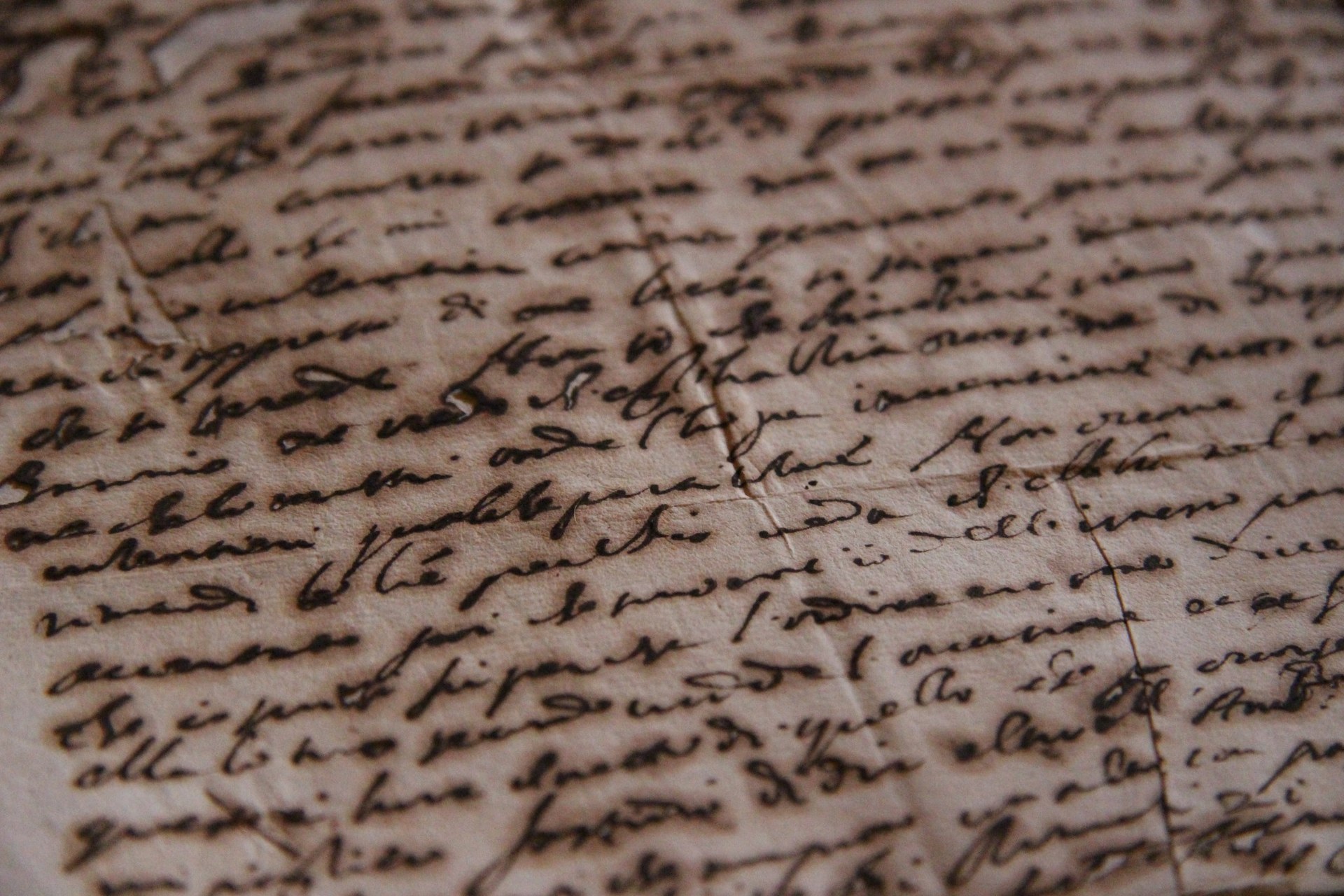
Paleography is concerned with historical writing: how it was formed, how it changed, how it can be read and, in many cases, how a written witness can be dated or localised through its graphic features. Transcription and translation enter at a different stage. They may form part of the same piece of archival work, and they may even be carried out by the same scholar, but they answer different questions; treating them as interchangeable obscures both the method and the evidential limits of the resulting text. The distinction matters because a historical document does not pass directly from manuscript to meaning. Before an Italian, Latin or French text can be translated, somebody must first establish what is actually written on the page; before that reading can be used by another researcher, it may need to be represented in a transcription whose conventions make clear what has been preserved, expanded, normalised or left uncertain. What appears to be a single operation is therefore, particularly with difficult material, a sequence of related but methodologically distinct acts.
Paleography is more than deciphering difficult handwriting
Paleography is sometimes described informally as the ability to read old handwriting. That is useful as a first approximation, but it is too narrow. Paleography is a historical discipline concerned with written testimonies and their graphic forms: it examines their development, decodes them, and may contribute to their dating and localisation, while also taking account of features such as abbreviations, punctuation and the organisation of writing on the page. For the archival researcher, however, those larger disciplinary questions have an immediate practical consequence: historical writing cannot simply be approached as though it were modern handwriting executed less neatly. Letter forms change over time; the same letter may appear in markedly different forms within a single hand, while two apparently similar signs may represent entirely different letters. Abbreviations may depend upon period, documentary genre or scribal habit; punctuation can operate according to conventions far removed from modern usage, and names, titles or numerical expressions may be particularly vulnerable to misreading. Nor does linguistic competence remove the difficulty. A researcher may know Latin extremely well and still struggle with a heavily abbreviated notarial hand; another may speak Italian fluently yet be unable to establish the wording of a seventeenth-century document. Language and script interact constantly, of course, because grammatical expectation and documentary formulae often help to resolve an uncertain reading; they nevertheless remain distinct forms of expertise. This is one reason why paleographic reading is evidential rather than merely mechanical. A doubtful letter is tested against the word in which it occurs, the language of the document, comparable forms elsewhere in the same hand, the formulae characteristic of the document type and, where relevant, external information such as personal names or place names. The reading emerges from the convergence of those clues; where they do not converge securely, uncertainty should remain visible.
Transcription establishes a textual representation of the source
Once the manuscript has been read, it can be transcribed. Here the crucial distinction is simple, although often misunderstood: transcription does not change the language of the document. A seventeenth-century Italian letter remains Italian when transcribed; a Latin deed remains Latin. What changes is the form in which the text is presented. Handwritten signs are represented typographically so that the wording can be read, checked, cited and, where necessary, subjected to further analysis without requiring every subsequent reader to decipher the original hand afresh. Yet, transcription is not neutral copying. The moment a manuscript is transferred into type, editorial decisions arise: should abbreviations be retained or expanded; should original spelling and punctuation be preserved; how should superscript letters, deletions, insertions or interlinear additions be represented; what happens when a word is damaged, partially illegible or only tentatively identified? Different projects require different answers. A diplomatic or highly conservative transcription may preserve a substantial part of the textual and graphic evidence of the source, whereas a more lightly normalised transcription may privilege accessibility; neither is intrinsically superior, provided that the convention is appropriate to the purpose and applied consistently. What is problematic is an unacknowledged normalisation that silently removes precisely those features on which another researcher might wish to base a different reading. The same applies to uncertainty. If a surname is only probable, a transcription should not transform probability into fact merely because an unresolved reading looks untidy on the page. Brackets, question marks, indications of lacunae or other editorial conventions are not defects in the finished text; properly used, they preserve the boundary between what the document supports securely and what remains open to interpretation. That principle is closely related to a broader feature of professional archival work discussed in Archivitaly’s article What Makes an Archival Research Report Useful?: documentation should allow a later reader to distinguish evidence from interpretation and to reconstruct how a conclusion was reached. A transcription performs the same function at textual level.
Translation begins only after the text has been established
Translation asks a different question: it is no longer primarily concerned with which signs appear on the manuscript, but with how the meaning of the resulting text should be rendered in another language. That distinction becomes especially important when the source is difficult. If a manuscript is clearly written, the stages may occur so quickly that they seem almost simultaneous: the reader recognises the words and mentally translates them at once. With an abbreviated, damaged or ambiguous document, however, the underlying sequence becomes impossible to ignore. The hand must first be deciphered; the source-language text must then be established with an appropriate degree of confidence; only after that can a translation responsibly be produced. Errors therefore propagate from one stage to the next. A misread letter may alter a surname; the wrong expansion of an abbreviation may change an office, title or legal formula; a numeral read incorrectly can affect a date, amount or quantity. Once that defective reading has been absorbed into fluent English, the problem becomes harder rather than easier to detect, because grammatical prose creates an appearance of certainty that the manuscript itself may never have warranted. Translation introduces further interpretative questions of its own. Historical legal, ecclesiastical, administrative, commercial or material vocabulary may have no exact modern equivalent; a term can carry an institutional meaning that is lost if translated according to its most obvious dictionary sense. The translator must then decide whether to preserve the original term, select an approximate equivalent, add an explanatory qualification or acknowledge that the passage permits more than one interpretation. These are translation problems rather than paleographic ones, although they rest entirely upon the paleographic reading that precedes them.
The same scholar may perform all three tasks; the tasks do not therefore become identical
In practice, there is substantial overlap. A researcher specialising in early modern Italian archives may have the linguistic, paleographic and historical competence required to read a document, transcribe it and translate it into English; indeed, separating the work among several people would sometimes be artificial and inefficient. Methodological distinction, however, does not depend upon division of labour. Even when one person performs the entire process, the questions remain different: What graphic signs are present? What source-language text do those signs represent? What does that text mean in another language? Recognising the distinction also helps to define the expertise a project actually requires. A clearly written eighteenth-century letter and a densely abbreviated sixteenth-century notarial act may both be described by a client as “an old Italian document”, yet they pose radically different problems. The first may require little specialist paleography; the second may depend upon familiarity with a particular script, documentary tradition and system of abbreviation before translation can even begin. For the same reason, a request for “a translation” may conceal a substantial preliminary task. If the text supplied to the translator is already securely transcribed, the work is principally linguistic; if the only source is a difficult manuscript image, the assignment necessarily includes the prior establishment of the text, whether or not the client initially describes it in those terms.
Why the distinction matters for archival evidence
Separating paleography, transcription and translation is not terminological pedantry; it preserves the chain of evidence. Suppose, for example, that a seventeenth-century inventory appears to contain the name of an artist, owner or place that is central to a research question. There are several analytically distinct propositions involved: that a particular sequence of graphic signs appears in the manuscript; that those signs can reasonably be read as a particular word or name; that the word has been transcribed according to stated conventions; and, where translation is involved, that its meaning has been rendered appropriately in another language. If those stages are collapsed, interpretation can begin to work backwards. The meaning expected by the researcher may influence the transcription; the expected transcription may, in turn, make one paleographic reading appear more persuasive than its alternatives. What began as a hypothesis can thereby enter the textual record almost unnoticed. A more rigorous method proceeds in the opposite direction. The manuscript constrains the paleographic reading; the reading constrains the transcription; the established text constrains the translation. Interpretation remains necessary throughout, because none of these activities is wholly automatic, but the direction of travel should remain clear. This becomes particularly important in provenance research, legal-historical work, attribution history and any other context in which a name, date, sum, place or formula may carry significant evidential weight. The more consequential the conclusion, the more important it is to know whether uncertainty belongs to the manuscript itself, to its paleographic interpretation or to the subsequent translation.
Before asking what a document means, establish what it says
Paleography, transcription and translation therefore belong to a connected scholarly workflow, but they perform different intellectual functions. Paleography examines and decodes the written witness; transcription establishes a textual representation of it, according to conventions that should make both intervention and uncertainty visible; translation then carries that established text into another language, introducing a further layer of linguistic and historical judgement. With easy material, these distinctions may seem almost academic. With difficult archival sources, they become fundamental, because each stage determines the reliability of the next. The first question to ask of a manuscript is not yet how it should be translated, nor even what we would like it to mean. It is more exacting than that: what, on the evidence of the writing itself, can we actually read?


